Hermes Agent kanban, step by step: five commands
By Riz Pabani on 30-Nov-2026
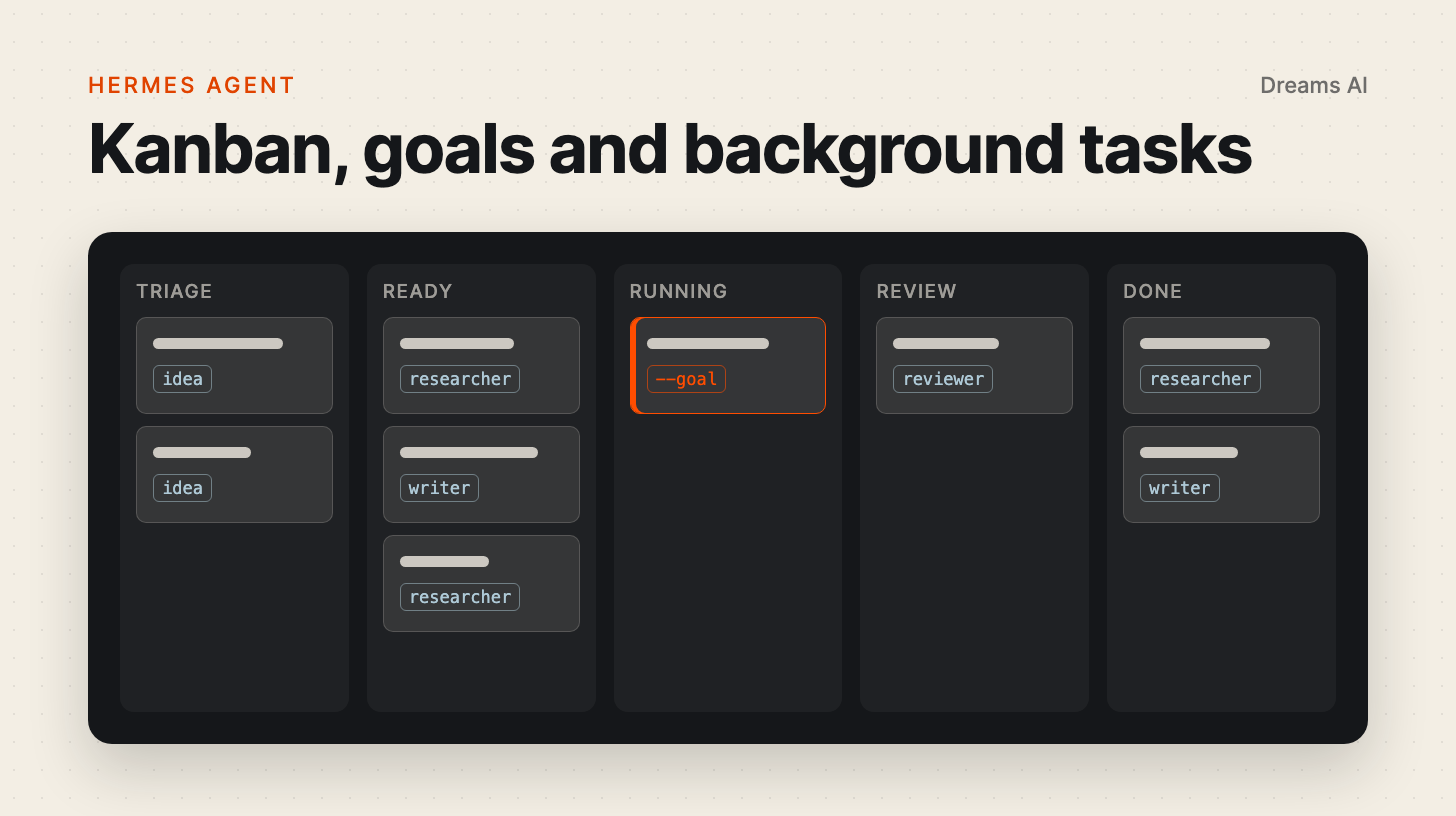
Hermes Agent gives you three ways to keep work moving without typing "keep going". Use /goal when you want one chat to loop on a task until a judge model says it's done (20 turns by default). Use /bg when you want a separate session working in parallel while you carry on. Use the kanban board when work has to pass between named agents, survive a restart, or wait for your input: run hermes kanban init, start the gateway, create tasks with --assignee, and watch them get picked up.
Want this running on your own machine rather than reading about it? That's what my 90-minute 1-2-1 is for. See what happens in a session
What's changed since May
I wrote a guide to kanban, goals and background tasks in May. Hermes has shipped a lot since (the latest release is v0.23.5, dated 27 November), and three things work differently now:
- The kanban dispatcher now runs inside the gateway. If
hermes gateway startis running, ready tasks get picked up on the next tick, 60 seconds by default. Running a separate kanban daemon is deprecated (Hermes docs: Kanban). - The board now has a triage column, where rough ideas get split into child tasks, and a review stage, so one agent can check another's work.
/goalgot stricter, with completion contracts. More on that below, because it fixes the exact problem I had.
Which one do you need?
The docs draw a sharp line here (Persistent Goals):
- One thing, in this chat, until it's done:
/goal. It never creates a kanban card. - Something on the side while you keep chatting:
/bg, a separate background session whose result appears when it finishes (Slash Commands Reference). - Many tasks, several agents, or work that must outlive your terminal: kanban.
- One board task that should keep going until it's right: a kanban card created with
--goal.
My own rule is simpler. If you have one agent, you don't need the board yet.
Hermes kanban, step by step
The board is a SQLite file at ~/.hermes/kanban.db, shared by all your Hermes profiles. Each task has one assignee (a profile name) and each worker runs as its own process. Five commands from the docs' quick start:
hermes kanban initcreates the board. You do this once.hermes gateway startstarts the gateway, which hosts the dispatcher. No gateway, no pickup: tasks sit in ready until one is running.hermes kanban create "research kids' events in December" --assignee researcheradds a task for the profile called researcher. Add--parent <task id>to make one task wait for another.hermes kanban watchshows activity live.hermes kanban list(orhermes dashboardand the Kanban tab) shows the board.
From there the agent drives its own card: it reads the task, does the work, then marks it complete, asks for review, or blocks with a reason. Blocked tasks wait for you. Create tasks from your phone with /kanban create in your chat app and that chat gets a message when the task completes or blocks.
For a walkthrough with screenshots of a live board, see running multiple Hermes agents on one server.
In May I said I hadn't started using kanban. I have now. My board manages a lot of the GEO and SEO work for this site.
Goals: the honest version
In May I set a goal to find 30 dated kids' events near London over the next three months, from seven sites I'd listed (Day Out With The Kids, Eventbrite, Happity and a few others). It hit 30 in about five minutes, all from Skiddle, which I hadn't listed, because Skiddle is easy to scrape and my sites aren't. Getting it onto my actual sources took about four hours of me checking in every 30 to 60 minutes.
Now you can write the rules down at the start. A goal can carry a completion contract: what done means, how to prove it, what's in scope and when to stop and ask. Write it inline, or type /goal draft and let Hermes draft one for you to check. What I'd write today:
/goal Find 30 dated kids' events near London for the next three months
verify: a table with date, venue, price and source link for each event
boundaries: only the seven sites I listed (Day Out With The Kids, Eventbrite, Happity and four more)
stop when: a listed site blocks access, so I can decide what to do
With a contract, the judge only marks the goal done on concrete evidence. /subgoal adds a criterion mid-run without restarting, and /goal resume still resets the 20-turn counter. It's still a junior colleague grinding through volume while you make the judgement calls. It just has a clearer brief.
What I actually run
My most useful agent isn't fancy. Our kids' two schools send about five dense newsletters a week. A Hermes agent reads them and sends my wife and me one Friday summary: dates, things to bring, things to pay. In week one the summary included far too much. By week three it knew what we read and what we skip. One scheduled job, no board.
On 17 November Google launched Tasks in Gemini with nearly the same example: its VP of Labs forwarded a batch of school emails and "every date was on my calendar with my wife invited" (Google blog). It's rolling out free in the US, Japan, Korea, Canada, Australia and India. Not the UK, yet.
I also run a chief of staff with several bots under it, each with one job. The content bot drafts, a distribution bot reviews, and nothing goes out until I've approved that exact version. That's where handoffs matter and a shared board starts to make sense.
What I'd set up for you
In a 90-minute session:
- One Hermes agent with one recurring job (a school newsletter, a weekly inbox digest) sending to the chat app you already check.
- One
/goalwith a written contract on a real research task from your week. - A second profile if you want one. The board comes last.
FAQ
Is there a Hermes Agent dreaming mode? No. People mean goals, background sessions, the board or the curator working unattended. The curator reviews the skills Hermes writes for itself every 7 days and is prune-only by default (Hermes docs: Curator).
What's the difference between Hermes kanban and /goal?
/goal loops inside one chat until a judge says it's done. Kanban is a board of tasks, each run by its own worker, with handoffs between named agents.
Does the kanban board need the gateway running? Yes, by default. The dispatcher lives inside the gateway and checks for ready tasks every 60 seconds.
How many turns does /goal get?
20 by default (goals.max_turns in config.yaml). Then it pauses and tells you how to resume.
Do I need to be technical? You need to be comfortable in a terminal, or have someone set it up once. The hard part is writing a clear brief, in plain English.
Book a session
In a 90-minute 1-2-1 we set up Hermes on your own machine with one agent doing one real job, plus a goal with a written brief you can reuse. £699. You leave with it running.
Book your 90-minute session · Personal AI training in London
Related Articles
Hermes Agent best practices: 12 rules from daily use
12 Hermes Agent best practices from running it every day: model choice, pruning skills, the curator,...
AI email triage in 90 minutes: a setup for professionals
AI email triage for a London solicitor or consultant in one 90-minute session: the three piles, the ...
Claude Cowork habit: the 10-minute daily routine that sticks
The 10-minute Claude Cowork habit I'd give anyone who keeps forgetting to use it: one morning check,...
Claude Cowork scheduled tasks in the cloud: my AI briefing
Claude Cowork scheduled tasks now run in the cloud. How I rebuilt my daily AI briefing, the prompt I...