Kimi K2: The Open Source Model Changing Enterprise AI
By Riz Pabani on 02-Feb-2026
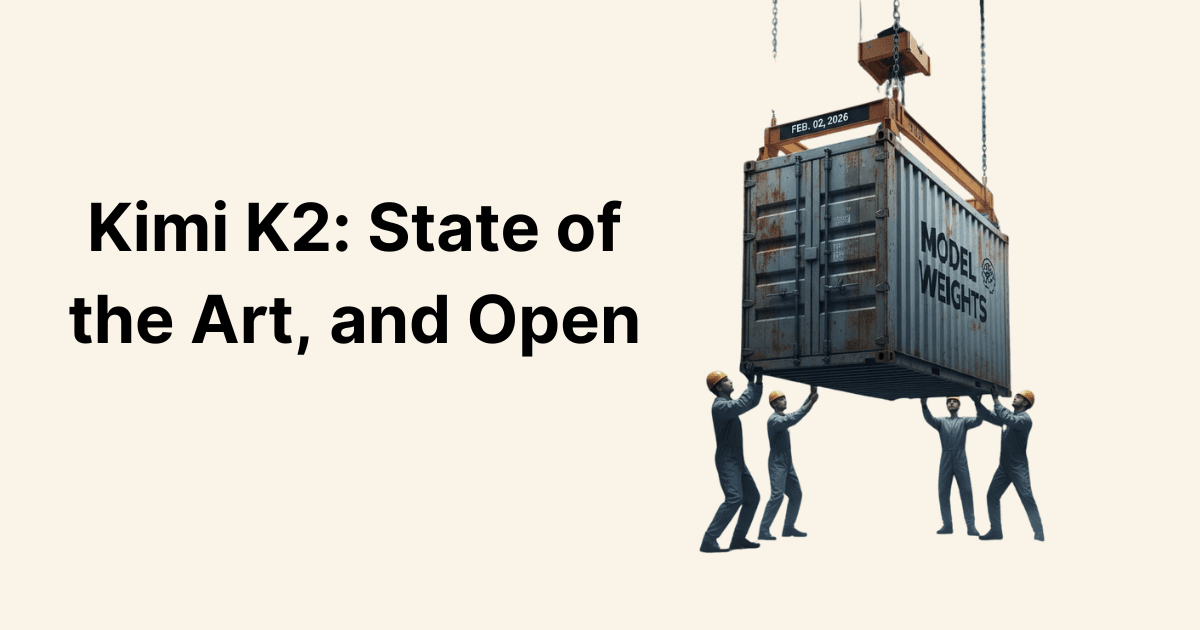
Large Language Models have been split into two camps.
Closed source models are what you're most familiar with — OpenAI's ChatGPT, Google's Gemini, and Anthropic's Claude.
These obviously aren't the model names but the brands. The key thing here is the models are proprietary.
This means they are generally only available via an API where you pay per token used. There are a mixture of subscriptions and other pricing models too, but you are essentially paying to use these on a token-by-token basis.
Tokens are akin to a syllable (sup-er is two tokens) and it's how LLMs calculate their costs. Tokens in (your prompt) and tokens out (the model's response).
Open source models take a different approach — the weights are publicly available for anyone to download, inspect, and modify.
The major players here include Meta's LLaMA, Mistral, and DeepSeek.
What "open source" actually means varies. Some models share weights but not training data. Others are fully transparent about everything. The term "open weights" is often more accurate than "open source" — you can use the model, but you don't always know how it was made.
Why Does This Matter for You?
- Cost — you can run open source models on your own infrastructure (or rented cloud servers) without per-token fees
- Privacy — data never leaves your environment
- Customisation — you can fine-tune the model on your own data for specific use cases
- Control — no dependency on a third party's pricing, policies, or availability
Enter Kimi K2
That changed this week with the launch of a new open source model called Kimi K2.
Built by Chinese AI lab Moonshot AI, Kimi K2 is a Mixture-of-Experts model with 1 trillion total parameters — putting it in the same weight class as the largest closed models.
It achieves state-of-the-art results on benchmarks testing reasoning, coding, and agent capabilities.
What makes this significant isn't just the benchmarks. It's that the model weights are publicly available — meaning anyone can download, run, and modify it.
The Business Value Proposition
For the CEO, the value proposition is simple:
- Total IP protection
- Immunity from third-party vendor outages
- Deterministic privacy that satisfies even the most stringent Swiss or EU regulations
One of the common myths propagated by the "Big Cloud" lobby is that high-performance AI requires a $100 million H100 cluster. Kimi K2 proves otherwise.
Many machine learning engineers and enterprise departments are now harnessing this intelligence factory capability through a one-time capex investment that replaces an agonisingly high opex API bill.
The best part is the hardware doesn't need to be Nvidia's latest H100. A couple of Mac Studios are sufficient for small outfits.
The Timing Couldn't Be Better
Clawdbot, now OpenClaw — allows users to run a proactive LLM with persistent memory, tools and browser access.
There are multiple examples of these bots executing workloads like managing emails, schedules and tasks seamlessly for hours on end.
One of the issues early adopters were facing was the exorbitant API costs. Every single minute the bot was working, it was costing more and more tokens.
As the memory, conversations and workloads grew and become more complex, the API bills really stacked up, reaching hundreds of dollars a day.
To set up OpenClaw on your own infrastructure, see our complete VPS setup guide.
A Few Words of Caution
- While the model is open, nothing beats doing a rigorous amount of testing over time to be sure it's as good as its benchmarks infer
- If teams spend a lot of time fine-tuning K2 and then K3 comes out, your forked version might become obsolete very quickly
- There is a risk sovereign states enforce restrictions given geopolitics — a Chinese-developed model may face scrutiny or outright bans in certain jurisdictions
- Running models locally requires in-house ML ops expertise — you're trading vendor dependency for operational complexity
Our OpenClaw configuration and security guide covers the hardening practices needed for self-hosted deployments.
The Bottom Line
Open source isn't automatically better than closed source. It's a different set of trade-offs.
Closed models offer simplicity, continuous improvement, and enterprise support. You're paying for someone else to handle the complexity.
Open models offer control, privacy, and long-term cost efficiency. You're paying with time, expertise, and infrastructure.
The smartest organisations aren't picking sides — they're building the internal capability to use both, switching between them as the economics and capabilities evolve.
The real question isn't "which model should we use?" It's "do we have the strategic flexibility to adapt as this market continues to shift beneath our feet?"
Related Articles
OpenClaw SEO Stack: Spotting Newsjack Opportunities in 2026
An OpenClaw SEO stack for solopreneurs: research, trend-jacking, task automation, and the Moltbook a...
OpenClaw Tips: Configuration, Optimization & Security
Master OpenClaw with tips on core configuration, thinking levels, Telegram usage, proactive automati...
How to Set Up OpenClaw on a Hostinger VPS with Ubuntu 24.04
A complete step-by-step guide to installing OpenClaw on a Hostinger VPS running Ubuntu 24.04, with s...
AI cited my site 18,400 times and I had no idea
Google Search Console has a hidden report on how often AI Overviews and AI Mode show your site. Mine...