How I Rank on Google Using Claude Cowork
By Riz Pabani on 06-Aug-2026

How I rank on Google using Claude Cowork (and I'm not an SEO expert)
Eight months ago my website got 26 clicks from Google over three months. Last month it did over 1,500. Impressions went from around 6,000 to more than a million. I haven't spent a penny on ads.
I should be upfront about two things.
First, I'm not an SEO expert. I didn't really know what a title tag was a year ago.
Second, this didn't happen overnight, and there's no clever trick I'm about to reveal. It took months. It's still going. What I've actually got is a system that Claude and I have built and tweaked, week after week, until it started working.
People have started messaging me to ask how. Strangers, mostly. So here's the whole thing, honestly.
It's me talking to an agent. That's it.
I use Claude Cowork. It's the desktop version of Claude that can read the files on my computer and run tasks on a schedule. I've written a fuller walkthrough of how I actually use Claude Cowork every day if you want the detail.
There's nothing complicated going on here. I'm not writing code. I'm not running some growth-hacking playbook. I'm having a conversation with an agent, in plain English, and we're figuring it out together as we go.
That's the part I most want people to hear. This is accessible. If you can describe what you want, you can do this. Honestly, it's been the single biggest change to how I run my business.
Skills, and why they take a while to get right
The useful bit of Cowork is something called skills.
A skill is a set of instructions you write once and save. After that, Claude follows them every time, exactly, without you re-explaining.
But nobody tells you the honest part. A good skill isn't something you write in an afternoon. Mine started rough. Claude would do the review, I'd read it, and I'd think "no, that's not quite what I meant." So I'd add a line. Tighten an instruction. Tell it to stop padding and give me decisions instead of data.
Do that for a few weeks and the instructions get sharp. My weekly review skill is now pages of hard-won detail, and the output is genuinely useful. That refinement is the work. There's no shortcut around it, and that's fine.
The site audit that fixed my actual website
One of the first things I did was get Claude to run an SEO site audit.
It went through my site and told me what was technically wrong. Missing meta descriptions. Slow pages. Broken structure. The stuff search engines quietly penalise you for. My site now passes those audit tests. It didn't before.
Then comes the bit I like. I take the audit output and hand it to Claude Code, which actually goes in and updates the website. Cowork finds the problems. Claude Code fixes them. I'm the one deciding what's worth doing.
The weekly review that runs while I sleep
Every Friday at 1am, Claude gets to work.
It pulls my Google Search Console data and looks at what ranked, what's climbing, and which new search terms have started showing up.
It pulls Semrush to check where I sit for the keywords I care about, who's beating me, and where the gaps are.
It checks my LinkedIn numbers.
Then it compares everything to last week and writes me a short review. Five minutes of reading. What happened, and what to write next.
It took weeks to get this scheduled task working the way I wanted. Now it just runs.
A database that gets more useful every week
Here's what I didn't expect. Doing this every week builds a record.
I've now got a lasting database of what keywords are working, which blog posts are popular, where my impressions are coming from, and where I'm getting feedback. Every Friday adds another layer.
That history is what makes the decisions good. I'm not guessing what to write. I'm looking at months of my own data and asking the same four questions every time.
What worked this week?
What should I write next week?
Which keyword am I chasing for the next month or two?
Is it actually moving?
Pillars
The other thing Claude and I worked out together is pillars. Instead of writing about whatever, we picked a few themes to own.
Articles about Claude Code. Articles about ChatGPT. Verticals I care about, like financial services and construction. Everything I publish ladders up to one of those.
That focus is half the reason it works. Search engines reward depth on a topic, and so do readers.
And now the AI search engines are sending people too
There's a newer version of all this called GEO. Same idea as SEO, but for AI search.
When someone asks ChatGPT, Perplexity or Gemini a question, those tools recommend sources, just like Google does. I'm starting to see visits from all three. People are asking an AI a question, and it's pointing them at me.
It's early, but it's real. And the work that helps you rank on Google is largely the same work that gets you mentioned by an AI.
Where the expertise actually comes from
Claude brings the SEO and GEO knowledge I don't have. I bring the business, the judgement, and the call on what's worth acting on. Neither half works without the other.
You don't need to become an expert. You need a system, a tool that already knows this stuff, and the patience to refine it over a few months.
Want to build this with you?
Ranking on Google is just one thing this approach is good for. If you've got a business you care about, the same way of working applies to automating your invoicing, your scheduling, your outreach. Jobs that used to take months now take days.
That's what I want more people to see. It's not magic and it's not complicated. It's a conversation with an agent that gets sharper every week, and anybody can do it.
So come and work with me. I'll show you exactly how I set this up, on your own business, with no ad budget and no code.
I do it one to one. Or, if you want your small business or team to get up to speed quickly, I run group sessions.
Book a session from the site, or just message me. I'll tell you honestly whether it's the right fit before you spend anything.
Related Articles

AI cited my site 18,400 times and I had no idea
Google Search Console has a hidden report on how often AI Overviews and AI Mode show your site. Mine...
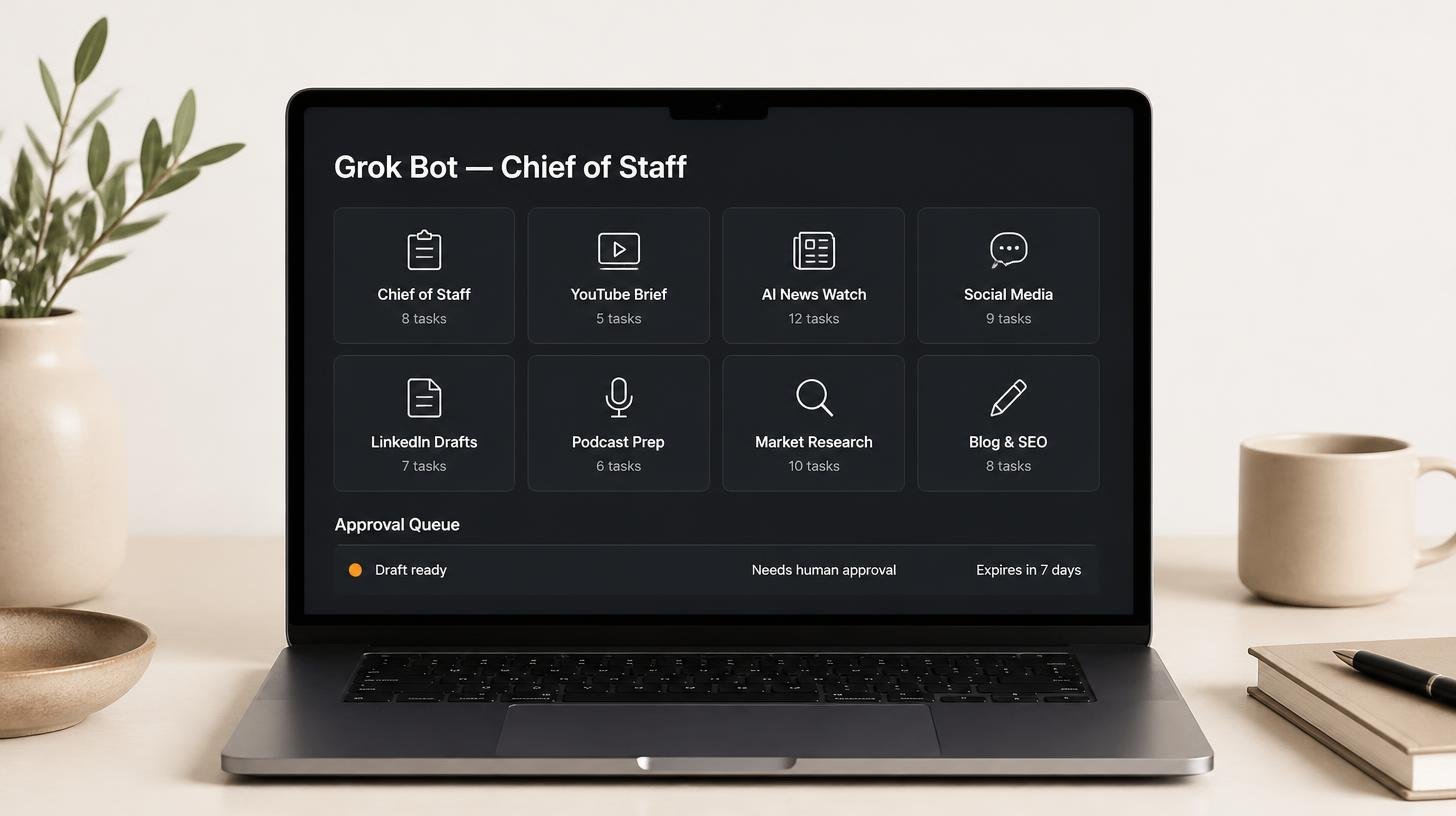
How my Grok Bot chief of staff grew into eight bots
Six weeks on, my Grok Bot chief of staff runs seven specialist bots. What they do each week, what br...

Claude skills for finance, and how to build your own
Claude skills for finance: the eight in Anthropic's Finance plugin, what they did on real data, and ...

How to create Claude Cowork skills by doing the work first
Build Claude Cowork skills that work first time. Do the task once, correct it, then have Claude pack...