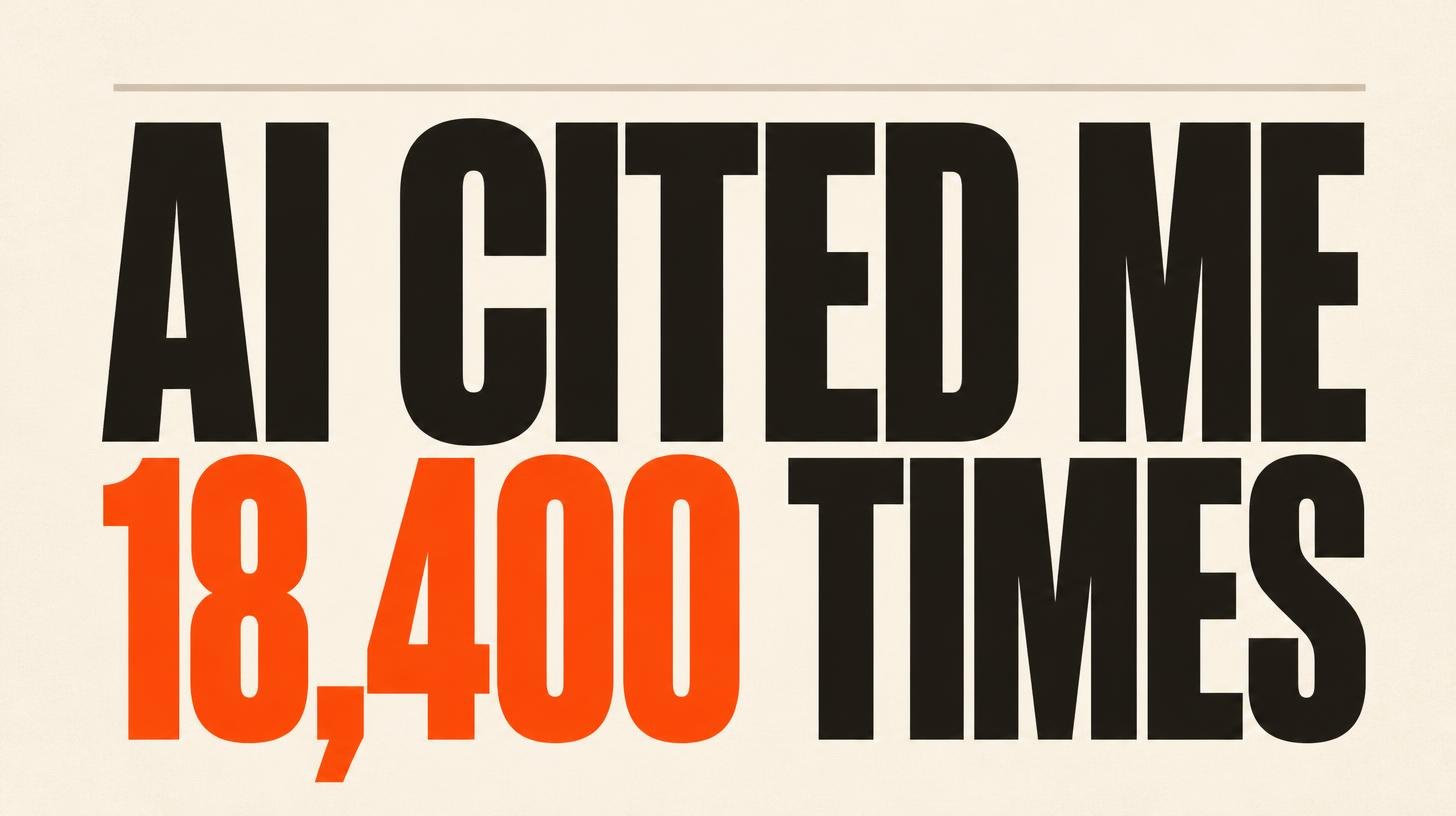
AI cited my site 18,400 times and I had no idea
By Riz Pabani on 14-Oct-2026
The numbers in this post come from Search Console and Bing Webmaster Tools in early September 2026.
For about eight months I have been trying to answer a question I could not measure: is any of this being read by the machines?
Not by people. By ChatGPT, by Google's AI Overviews, by Copilot. The thing every client now asks me some version of, usually phrased as "how do we show up in AI?"
I had one instrument. Bing Webmaster Tools has an AI Performance report that shows when Microsoft's Copilot cites your pages, and it is free, and it was telling me a fairly bleak story. Citations to my site fell from 223 to 113 to 39 over three consecutive months. By early September there was exactly one search query left in Microsoft's entire index that grounds an answer on anything I have written.
So I assumed I was losing. Then I found the report I should have been reading all along.
Google has been counting, and it did not tell me
On 3 June 2026, Google launched generative AI performance reports in Search Console. They rolled out slowly to a subset of sites, then went global to everyone with a Search Console account. It is still labelled Beta.
It shows how many times your pages appeared inside Google's generative AI features. AI Overviews. AI Mode. Discover.
It is not in the left-hand navigation. You get to it through an information banner on the Performance page that says "Get more details on your site's performance in generative AI features on Google Search", with a small "Open report" link on the right. I have opened that Performance page most weeks since June. I never clicked the banner.
Here is what it said when I did.
18,400 impressions. 59 pages. Ninety days.
Bing, over the same period, reported 1,800 citations across about nine pages. Google's AI surfaces have been showing my site roughly ten times more often than Microsoft's, and I had spent three months writing weekly reviews about the smaller number.
What I had wrong
The specific thing I had wrong is worth spelling out, because I suspect a lot of people believe it.
In July I wrote down, as a finding, that seven of my commercial pages had "never been cited once, on any query, in any window." The trainer pages. The service pages. The one that explains what happens in a session. Bing had never touched any of them, and Bing was all I could see. The conclusion I drew was that AI answers about tools and how-to questions, and does not answer questions about who to hire.
That was true of Microsoft and false of Google.
| Page | Google AI impressions (90d) | Bing citations (30d) |
|---|---|---|
| Claude trainer London | 84 | 0 |
| Best AI training providers UK | 83 | 8 |
| Personal AI training London | 42 | 0 |
| Homepage | 25 | 0 |
| Codex trainer London | 19 | 0 |
| Claude Cowork training | 10 | 0 |
| AI trainer London | 5 | 0 |
| ChatGPT trainer London | 3 | 0 |
| AI training for teams | 2 | 0 |
Eleven of my fourteen commercial pages show up in Google's AI answers. Three still do not, and those three are the newest and thinnest, which is its own lesson.
The numbers are small. Two hundred and eighty-two impressions in a quarter is not a business. But "small" and "zero" are different arguments, and I had been making the wrong one because I only owned one thermometer.
The column that actually matters
The instinct is to sort by the big number. That is not where the useful information is.
The useful information is the ratio between a page's AI impressions and its ordinary search impressions. That tells you what share of a page's visibility is happening inside an AI answer rather than in a list of blue links.
| Page | AI impressions | Ordinary impressions | Ratio |
|---|---|---|---|
| Claude models compared | 994 | 4,483 | 22.2% |
| Run multiple Hermes agents | 1,749 | 16,591 | 10.5% |
| Set up a daily AI briefing | 717 | 7,175 | 10.0% |
| OpenClaw vs Hermes vs Cowork | 1,999 | 21,971 | 9.1% |
| Best LLMs 2026 | 3,122 | 56,930 | 5.5% |
| Best AI tools 2026 | 329 | 38,934 | 0.8% |
The top of that table is a post I wrote in June, had not touched since, and had never once mentioned in a planning session. Nearly a quarter of everywhere it appears is inside an AI answer. It is the most AI-visible thing I own and I did not know it existed as an asset.
The bottom of the table is a page I had been arguing with myself about for four weeks. It gets 38,934 impressions, zero clicks, and it is almost invisible to AI as well. Two independent measurements, same verdict. That is a page to retire, and having the second measurement is what made the decision easy. I retired it on 18 September and pointed it at my guide to the best LLMs.
Why this matters more than it did last year
The context is that clicks are draining out of search.
SparkToro's analysis put zero-click searches at 68% of US queries in early 2026, up from around 60% two years earlier. Less than a third of Google searches now send a click anywhere. Where an AI Overview appears, click-through rates on the top organic result fall by around 58%, and the zero-click rate for those queries runs at 80% or higher.
Worth being precise about the causation: zero-click search has been climbing since about 2016, first through featured snippets and knowledge panels. AI Overviews did not start the trend. They steepened it.
What that means practically is that "impressions with no clicks" is turning from a failure state into a normal one. If your page is quoted inside an answer and the person never visits, your analytics record nothing, and until June you had no way to know it happened at all.
I have one piece of direct evidence that it does happen. The largest new client I signed this summer, a trade body, found me through ChatGPT. Not through a search result. Through an AI answer that mentioned me, followed by an email. Nothing in Google Analytics, nothing in Search Console's click data, and no referral path.
How to check yours, in about four minutes
- Open Search Console and pick your property.
- Go to Performance. Do not use the left-hand navigation for the next step, because the report is not listed there until Performance is expanded.
- Under the chart there is a grey information banner about generative AI features. Click Open report on the right.
- Set the range to three months.
- Click the Pages tab.
Two warnings from doing this myself. The rows-per-page selector on this particular report silently refuses to move off ten, so you have to page through with the arrow, even though the same control works fine on the main performance table. And the report gives you impressions only. No clicks, no queries, no click-through rate, no average position. You are being told that you appeared, and nothing about what happened next.
The number nobody should trust yet
One more finding, and it is the uncomfortable one.
When I pulled my full query list, a large slice of it was not written by humans. Search strings with operators in them. Prompts with -site:pinterest.com appended. One query, at 1,674 impressions and zero clicks, was a request about a configuration default in a piece of agent software, phrased the way a machine phrases things. Another was somebody's shell command. Another was an instruction to compose a daily briefing and email it.
Roughly four to five thousand impressions out of my 422,000 were issued by agents, scrapers and research tools. They inflate impressions, they depress click-through rate, and they can never click on anything.
Which means some unknown share of both the growth I celebrated last year and the decline I had been writing about since July was never human demand in the first place. I do not yet know how much. Nobody selling you an AI visibility score knows either.
What I'm doing about it
Four things, and they are all cheap.
I am reporting AI impressions per page from now on, alongside clicks, in the same weekly review. Not as a vanity number. As the leading indicator for a channel that produced my biggest client this year and shows up nowhere in analytics.
I am reading the ratio column rather than the absolute one, which has already told me which page to retire and which page to build on.
I am going back to the page with the 22% ratio to work out why it earns that, because whatever it is doing is worth copying onto the pages I actually want found.
And I have stopped quoting my SEO tool's AI visibility panel. It reported three cited pages in the same ninety-day window that Google's own console reported fifty-nine. One of those is a sample. The other is a measurement.
Questions people ask me about this
Does this report show ChatGPT citations? No. It covers Google's own generative surfaces: AI Overviews, AI Mode and Discover. Bing Webmaster Tools covers Microsoft Copilot and its partners. Neither covers ChatGPT directly, which is a real gap, and it happens to be the channel that has produced actual revenue for me.
Is 18,400 impressions good? I have no idea, and neither does anyone else yet. The report is months old and there is no benchmark. What it is good for is comparison against yourself over time, and comparison between your own pages.
Why are there no clicks in the report? Google has not included them. For AI Mode in particular there often is no click to record. Treat the number as visibility rather than traffic.
My site shows zero. What now? Check that you are looking at the right property, then check that the pages you care about are actually indexed. A page in "crawled, currently not indexed" cannot appear anywhere. After that it is the ordinary work: be the clearest answer to a question somebody actually asks.
Should I be optimising for this? Carefully. The pages of mine that AI surfaces most are comparisons and specific how-to walkthroughs with real numbers in them. The pages it ignores are the dated list posts. That is a fairly old lesson wearing new clothes.
If you want to know what your own numbers say, and what to do about them, that is what a session is for.
Related: Best AI training providers in the UK (2026) · How I rank on Google using Claude Cowork · Claude models compared
Related Articles
How my Grok Bot chief of staff grew into eight bots
Six weeks on, my Grok Bot chief of staff runs seven specialist bots. What they do each week, what br...
Claude skills for finance, and how to build your own
Claude skills for finance: the eight in Anthropic's Finance plugin, what they did on real data, and ...
How to create Claude Cowork skills by doing the work first
Build Claude Cowork skills that work first time. Do the task once, correct it, then have Claude pack...
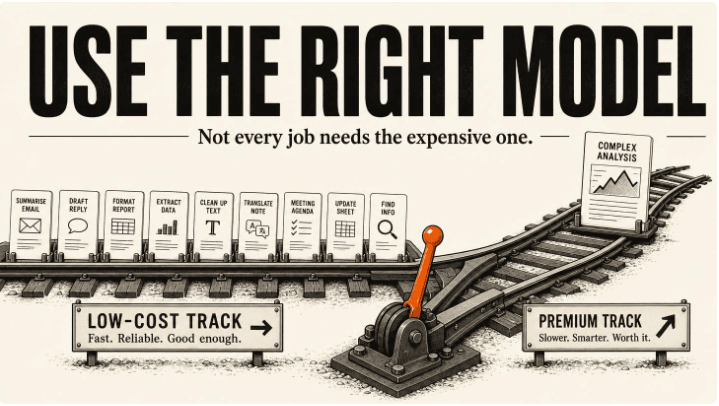
How to cut AI costs with a model router
Most people run every task through one expensive AI model. A model router sends easy work to cheap m...