How to cut AI costs with a model router
By Riz Pabani on 28-Sept-2026
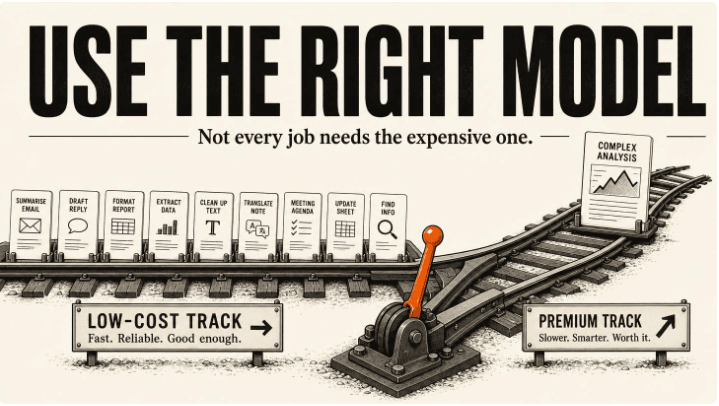
Most people pick one AI model and run everything through it.
The quick email rewrite, the shopping list, the dense legal summary, the tricky bit of code. All of it goes to the most expensive model they're paying for, because surely the best model is the best choice for everything.
It isn't. For most of what we ask AI to do all day, paying frontier prices is money thrown away. If you want to cut AI costs without getting worse results, there's a better way to think about it, and the idea has a name that sounds more complicated than it is: a router.
What a model router actually is
I picked this up listening to Gavin Baker and Brian Armstrong talking about where AI is heading. Baker pointed to Andrej Karpathy's idea of a "council" of LLMs, where several models work on a problem together instead of one doing everything. The practical, everyday version of that thinking is a router.
<!-- [RIZ: CONFIRM — check Baker's exact framing of the Karpathy "council" point in the episode, and name the podcast/episode if you want to link it.] -->A router is simple. Before a task gets done, something looks at it and decides which model should handle it. Easy jobs go to a cheap or free model. The genuinely hard ones, where quality really matters, get sent up to a top-tier frontier model.
That's it. It's the same decision a sensible manager makes every day. You don't put your most expensive person on sorting the post. You give them the work that actually needs them, and you let cheaper resource handle the rest.
The reason this is suddenly worth caring about is the maths underneath it.
The number that should change how you buy AI
Baker made a point that stuck with me. Frontier models, the expensive ones from the big labs, capture roughly 90% of the money in AI. But more than 80% of the actual work, measured in tokens, runs on cheaper open models.
<!-- [RIZ: CONFIRM exact wording and figures from the episode before publishing.] -->So most of the work doesn't need the expensive model. We just pay for it out of habit.
If 80% of what you ask AI to do could run on something far cheaper at no real loss in quality, then running all of it through the premium option is a tax you've decided to pay. A router is how you stop paying it.
Why this works now and didn't a year ago
This advice would have been weaker eighteen months ago, because the cheap models weren't good enough to trust with anything that mattered. That's changed fast.
Take GLM 5.2, an open model out of China. On coding benchmarks it's landing within a whisker of the best paid models, and the API runs something like 85% cheaper than the comparable premium option. It's free to download and run if you want to.
<!-- [RIZ: CONFIRM the GLM 5.2 benchmark claim and the 85% price figure against a current source.] -->I'm not telling you to go and self-host a Chinese model. The point is broader. The gap between "free or cheap" and "best in the world" has narrowed to the point where, for everyday tasks, you genuinely can't tell which one wrote the answer. Once that's true, defaulting everything to the priciest model makes no sense.
What this looks like for a normal person or business
The version of this you read about is enterprise-scale. Big companies build an actual routing layer that fires the easy 80% of queries at a cheap model and only escalates the hard ones. Most of us don't need anything that clever.
For the rest of us, the router is a habit, not a piece of software. Before each task, ask one question: does this actually need the best model, or will a cheaper one do?
The shopping list, the tidy-up of a rough email, the "summarise this in three lines", the brainstorm of ten subject lines. None of that needs the flagship. A cheaper or free model handles it perfectly.
Then there's the work where quality and nuance really matter. The contract you're about to send. The analysis you're staking a decision on. The code going into something live. That's where you spend the money and reach for the frontier model.
<!-- [RIZ: ADD EXAMPLE — a real session moment where someone realised they were using an expensive model for trivial tasks.] -->If you want a longer breakdown of which kind of model suits which kind of job, I wrote about picking the right model for the right task.
How to cut AI costs without building anything
You don't need a developer. Three things get you most of the benefit today.
First, get access to more than one model. A tool like Abacus, which I think of as the Kayak of AI, gives you one subscription and lets you switch between most of the major models in a single place. That alone makes "pick the right model for the job" a real choice rather than a hassle.

Second, set a cheap model as your default. Make the expensive one the exception you reach for, not the thing that runs everything. Flip the habit.
Third, learn the difference between an easy task and a hard one for AI. This is the bit people get wrong. A task can feel hard to us and be easy for the model, or the reverse. Knowing which is which is most of the skill, and it's exactly the kind of thing that's quick to learn once someone shows you.
The honest catch
A router isn't free of trade-offs, and I'd rather you knew them.
Cheaper models can be worse at the subtle stuff. Long, nuanced reasoning, careful writing, tricky edge cases. If you route something delicate to a weak model to save a few pennies, you can pay for it in a worse result. The skill is in drawing the line in the right place.
There's also privacy. When you use a model through someone's app or API, your prompts go to that provider's servers, under their terms and the laws of wherever they're based. For a shopping list, who cares. For client files, contracts or anything personal, check where the data is processed and whether it's used for training before you send it. Cheaper isn't worth it if the trade is your confidential information sitting somewhere it shouldn't.
Get the line right, though, and you keep the quality where it counts and stop overpaying everywhere else. That's the whole game.
Where to start
If you're paying for AI and you've never once thought about which model should do which job, that's the first thing worth looking at. For most people it's the easiest way to cut AI costs and get the same or better results.
This is exactly the kind of thing we work through in a 1-2-1 session. I'll look at what you're actually using AI for, show you where you're overpaying, and set you up so the right job goes to the right model. The session is £599 for 90 minutes.
If you're not sure whether that's right for you, message me. I'll tell you honestly.
Related Articles
AI cited my site 18,400 times and I had no idea
Google Search Console has a hidden report on how often AI Overviews and AI Mode show your site. Mine...
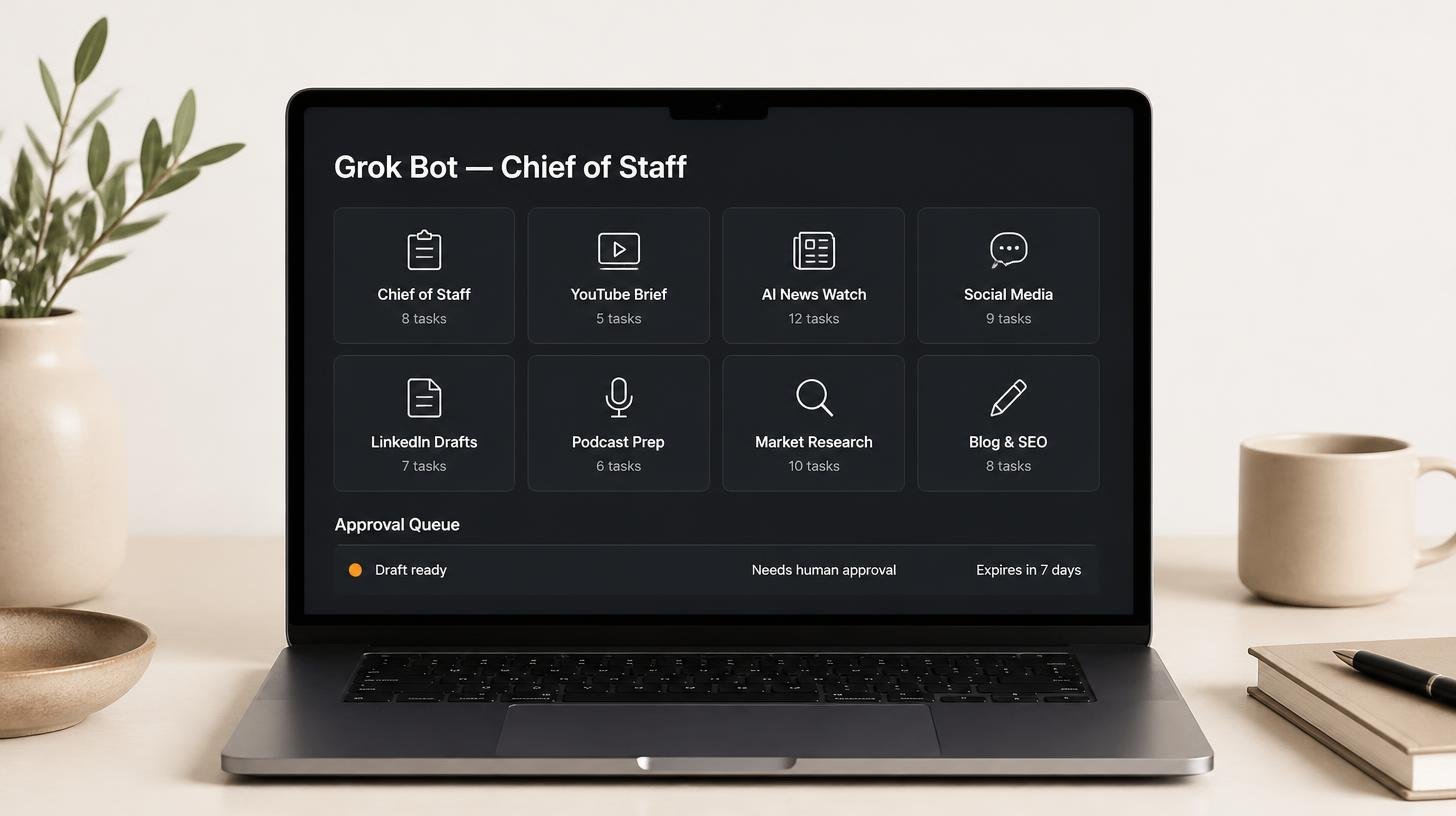
How my Grok Bot chief of staff grew into eight bots
Six weeks on, my Grok Bot chief of staff runs seven specialist bots. What they do each week, what br...
Claude skills for finance, and how to build your own
Claude skills for finance: the eight in Anthropic's Finance plugin, what they did on real data, and ...
How to create Claude Cowork skills by doing the work first
Build Claude Cowork skills that work first time. Do the task once, correct it, then have Claude pack...