Claude models compared 2026: Fable, Opus, Sonnet, Haiku
By Riz Pabani on 14-Sept-2026
I keep a running note of the questions clients ask in the first ten minutes of a session. Near the top, all year: which Claude am I supposed to be using?
It is a fair question and it has got harder to answer. In June 2026 Anthropic added a tier above Opus, called it Fable, took it offline for nineteen days, brought it back, and then shipped a point upgrade in September that changed the pricing shape again. Anyone who learned this lineup a year ago has learned a lineup that no longer exists.
So here is the plain-English version: the Claude models compared, current as of 4 September 2026, with prices from Anthropic's own documentation and the awkward parts left in.
The four tiers, in one paragraph each
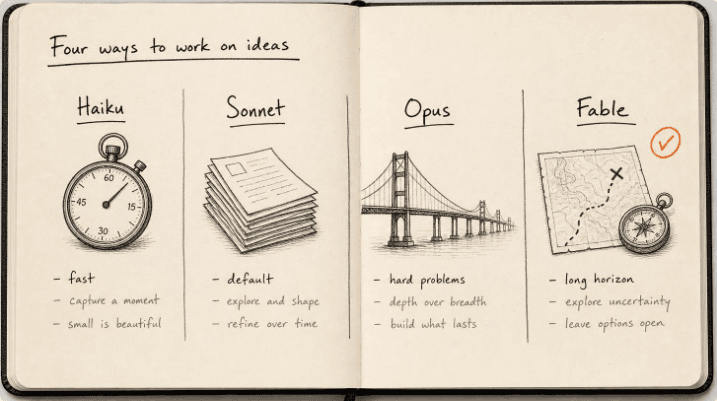
Haiku 4.5 is the fast, cheap one. $1 per million input tokens and $5 per million output, a 200,000-token context window, and up to 64,000 tokens of output. It matches what Sonnet 4 could do on coding, computer use and agent tasks, which is a useful way to think about it: last year's mid-tier, at this year's bottom-tier price. Use it for high-volume, low-judgment work.
Sonnet 5 is the default for most API work. $2 per million input and $10 per million output, with a one-million-token context window. Anthropic's own guidance is that most applications should sit here, and the independent write-ups agree: it is roughly 60% cheaper per token than Opus and close enough in quality that the difference only shows on genuinely hard problems. If you are building on the API without a strong reason to go bigger, choose this.
Opus 5 is the heavy one. $5 per million input, $25 per million output, one-million-token context, 128,000 tokens of output. It is built for complex agentic work and long-horizon reasoning: the tasks where the model has to hold a lot in its head for a long time and where being wrong is expensive.
Fable 5.1 sits above all of them. $10 per million input and $50 per million output. Anthropic classes it as a "Mythos-class" model, which is their name for a tier above Opus, and describes it as their most advanced model for coding and knowledge work.
The Claude models compared, on one table
| Model | Input (per 1M tokens) | Output (per 1M tokens) | Context window |
|---|---|---|---|
| Haiku 4.5 | $1 | $5 | 200K |
| Sonnet 5 | $2 | $10 | 1M |
| Opus 5 | $5 | $25 | 1M |
| Fable 5.1 | $10 | $50 | 1M |
Two things sit underneath that table and change the real cost a lot.
Batch processing takes 50% off. If the work does not need to happen this second, it costs half as much.
And prompt caching now matters more than the headline rate. With Fable 5.1 in September, Anthropic cut cache reads by 75%, to $0.25 per million tokens. Their own figure is that this reduces typical Fable workloads by around 25%, and highly agentic ones (the context-heavy, tool-heavy work where the model keeps re-reading the same material) by up to about 45%. If you are running agents rather than chatting, the sticker price is not the number that governs your bill.
What actually changed in 2026
Three things, and the second one is the one people underestimate.
Fable arrived above Opus. Anthropic launched Fable 5 on 9 June at $10/$50, describing it as state of the art on nearly all tested benchmarks and noting that the longer and more complex the task, the larger its lead. Their launch material cites Stripe performing a codebase-wide migration in a 50-million-line Ruby codebase in a day, work they say would have taken a team over two months by hand.
Then the US government switched it off. On 12 June, Anthropic received an export-control directive instructing it to suspend access to Fable 5 and Mythos 5 for any foreign national anywhere in the world. With no way to verify nationality in real time, Anthropic suspended both models for everybody. The trigger, per trade coverage, was Amazon researchers finding a jailbreak that got the model to identify software vulnerabilities and in one case produce exploit code. Anthropic publicly disagreed with the order, calling it a misuse of the standard, and said its own review found only narrow, non-universal capabilities already present in competing frontier models. The Commerce Department lifted the order on 30 June and Anthropic redeployed on 1 July, with a new classifier that blocks the flagged technique in over 99% of cases.
Nineteen days. That is the number worth remembering if you are deciding what to build a business process on.
Then September made it cheaper and less annoying. Fable 5.1 kept the $10/$50 headline but cut cache reads, and Anthropic loosened the safeguards that had been the main complaint: cybersecurity safeguards now block 60% fewer false positives, and the biology safeguards fire 85% less often on benign questions about elementary biology and medicine. They also introduced Enterprise Frontier Safeguards, which lets enterprise customers keep data in their own cloud rather than Anthropic's, addressing the 30-day retention requirement that had come in with Fable 5.
The thing nobody tells you: you might not get the model you paid for
This is the part I explain in sessions more than any other, and it is not in most comparison articles.
Fable runs behind a set of classifiers. When those classifiers detect a request touching cybersecurity, biology and chemistry, or attempts to extract the model's capabilities, the answer is generated by a different, less capable model instead. That model is Claude Opus 4.8, and you are told when it happens. Anthropic's own framing is that a fallback to Opus is a better experience than an outright refusal, which is true. Their early data put it at fewer than 5% of Fable sessions, and they have been narrowing it since.
Two practical consequences.
If you work in security, life sciences or medicine, a meaningful share of your Fable queries will be answered by a cheaper model while you pay Fable rates. September's changes narrowed this considerably and did not remove it. Penetration testing, exploit generation and binary vulnerability scanning still redirect.
And it distorts the benchmarks. Anthropic say so themselves, in a footnote most people skip: Fable 5.1 was evaluated with production safeguards enabled, and on tasks where the safeguards intervened, it scored zero. The published numbers understate the underlying model and describe the product you actually buy. That is the honest way round, and it is worth knowing which one you are reading.
I've hit the fallback in a session myself. It comes up most when the company works on biochemical or cybersecurity problems, and Anthropic are very conservative about where they draw that line. If that's your field, expect some of your Fable answers to come from Opus 4.8, and watch for the notice that tells you when it happens.
The benchmarks, with the caveat attached
These are Anthropic's own figures from the Fable 5.1 announcement. Treat them as the vendor's, because they are.
| Benchmark | Fable 5.1 | Fable 5 | Opus 5 | GPT-5.6 Sol |
|---|---|---|---|---|
| Agentic scientific research (Terminal-Bench-Science 0.1) | 52.6% | 24.7% | 29.0% | 22.4% |
| Agentic coding (Terminal-Bench 4.0) | 55.8% | 42.0% | 52.3% | 37.3% |
| Knowledge work (GDPval-AA v2) | 1853 | 1723 | 1824 | 1711 |
| Multidisciplinary reasoning (Humanity's Last Exam, no tools) | 60.9% | 57.8% | 56.6% | n/a |
| Business workflows (AutomationBench) | 31.4% | 17.1% | 26.9% | 19.6% |
| Agentic coding (CursorBench 3.2.0) | 73.4% | 70.5% | 70.0% | 67.2% |
Read the Opus 5 column rather than the Fable 5.1 one. On knowledge work, the two are 1853 against 1824. On CursorBench, 73.4% against 70.0%. For most business work the gap between the tier above Opus and Opus itself is small, and the price gap is double.
The gap is large in one place: agentic scientific research, where Fable 5.1 roughly doubles Opus 5. If your work looks like a research project that runs for hours without supervision, that is where the money goes.
Two customer quotes from Anthropic's own launch page are worth repeating because they say the useful thing. Dan Shipper at Every: "Fable-level intelligence, Opus-level price, Sonnet-speed. In our tests it was about twice as fast as Opus 5 and used half as many tokens." And Cognition said they were moving their Opus 5 traffic in Devin to Fable 5.1 on launch day, because the new cache pricing made a Fable-class model economical for workloads they had kept on Opus.
So which one should you actually use?
My short answer: if you can use Fable, use it.
It's an exceptional model. Anthropic pitches it at long-horizon work, and that's where the benchmark gap is widest. What I notice day to day is simpler. It's very, very capable and it's great to work with.
My own setup depends on how heavy the workload is. When I'm building software I'm on the top Max plan, about £200 a month, and I run Fable 5.1 for nearly everything. It acts as the orchestrator. When the work actually touches the code, I ask it to hand that part to Opus 5 as a sub-agent, and that helps.
For knowledge work (CRM, planning, that sort of thing) Opus 5 has been my daily driver lately. It seems to have got better recently. There was a stretch where Opus annoyed me: too verbose, and it spoke in a slightly odd way. For a while I went back to Opus 4.8 and used nothing else.
My general advice is this. We're in an age where intelligence is almost like electricity. At the very least, experiment with the frontier models, especially when you're doing work that really matters to you. It makes a big difference.
What your plan actually gets you
Which model you can reach depends on what you pay. As of 11 September 2026, per Anthropic's help centre:
| Plan | Fable 5 and 5.1 |
|---|---|
| Free | Not available |
| Pro (about £20 a month) | Not included in your usage limits. Usage credits only |
| Max | Included. Up to 50% of your weekly usage can go on Fable |
| Team and seat-based Enterprise | Premium seats get the Max terms. Standard seats need usage credits |
| Usage-based Enterprise | Billed at API rates |
So on the £20 plan, Fable costs extra. In my experience even Opus doesn't give you many goes on Pro before you hit the limit and get nudged towards a bigger plan.
Where Sonnet and Haiku earn their place
The smaller models make the most sense when you're paying per call through the API, rather than chatting.
Use Haiku 4.5 when volume is the problem: classifying a thousand emails, tagging a backlog, first-pass triage. Use Sonnet 5 inside an app or automation where the task is well defined and the cost per call adds up. That's where Anthropic's own guidance points most API applications.
If you're paying API rates for Fable, save it for work that runs for hours. Long agentic tasks, deep research, large migrations. At $50 per million output tokens, that's where it earns its price back.
One practical note that catches people out: Fable 5.1 defaults to different effort levels in different places. High effort in Claude Code, Medium in Claude Cowork and on claude.ai. Same model, different cost and different speed, depending on which door you came through.
Model choice and effort matter more than people think
Model choice and thinking effort are a big deal, and there's a simple riddle that shows why.
"I want to wash my car. The car wash is 50 metres away. Should I walk or drive?"
You drive. The car has to be at the car wash. An instant model will often tell you to walk, because 50 metres is a short walk. A model that thinks before it answers usually gets it right.
When Opper ran that question ten times through each of 53 models, 33 never answered correctly once. Grok 4.1 got it wrong all ten times in its non-reasoning mode and right eight times out of ten with reasoning switched on. Same model family. The difference was whether it stopped to think.
Haiku and Sonnet are good models. They're in the lineup because Anthropic's business model is to cater for the whole market, and a lot of that market is on the free plan or the £20 plan. Those tiers are built around budgets. For work that matters to you, pick the model around the work.
The part that is about you: getting your intent across
Where I do see a gap that no model choice fixes, it's context. How much of what you actually want makes it into the conversation.
When you write a prompt, you're getting maybe 60% of what you mean onto the page. The rest stays in your head.
One of the first things I get people to do in a one-to-one session is ask the model to ask them three questions about what they're trying to do before it starts. Each answer draws out a bit more of the intent the prompt missed.
This is also one of the best things about the better models. They understand your intent better. Fable 5.1 is much more tuned to working out what you really meant behind a poorly worded prompt, and it will ask follow-up questions and keep digging.
In time, the models will come and meet you where you are. They'll be configured well enough to work out what you want before you've fully worked it out yourself. Until then, you have to do a bit of prompt engineering and context engineering. That's what I work on with people in the sessions.
Questions I get asked about this
What is the difference between Fable and Mythos? Same underlying model, different safeguards. Fable is generally available. Mythos has safeguards lifted in specific areas and goes only to vetted cyberdefenders and life sciences researchers through Anthropic's trusted access programmes. Anthropic's own explanation of the names: Fable comes from the Latin fabula, "that which is told", akin to the Greek mythos.
Is Fable 5.1 included in my Claude subscription? It depends on the plan. As of 11 September 2026: not on Free; on Pro only with usage credits; included on Max, where up to half your weekly usage can go on Fable. Team and seat-based Enterprise follow the seat, so premium seats get the Max terms and standard seats need credits. Usage-based Enterprise pays API rates. This has changed more than once since June, so check Anthropic's plan page before you rely on it.
Which model does Claude.ai use by default? It depends on your plan and what you pick. The effort-level default differs by surface: Fable 5.1 runs at Medium effort on claude.ai and Claude Cowork, and High in Claude Code.
Do I need the biggest model to get good results? For work that matters to you, use the best model your plan gives you, with thinking switched on. If Fable isn't on your plan, Opus 5 is a strong fallback: on Anthropic's own knowledge-work benchmark it sits about 1.6% behind Fable 5.1, at half the API price. The jump from an instant answer to a thinking one can be bigger than the jump between the top two tiers.
What happened to Opus 4.5 and Sonnet 4.5? Superseded. The current generation is Sonnet 5, Opus 5, Haiku 4.5 and Fable 5.1. Haiku is the one still on a 4-series number, which confuses people reasonably often.
Is it safe to put company information into these? That is a settings and policy question rather than a model question. Anthropic introduced Enterprise Frontier Safeguards in September 2026, which keeps enterprise data in the customer's own cloud infrastructure rather than Anthropic's. If you are on a consumer plan, the answer is different, and it is the first thing I go through in a session.
Prices and model details verified against Anthropic's own documentation on 4 September 2026. This lineup has changed four times this year. If you are reading this some months later, check.
If you want help working out which of these your team should actually be on, that is what a session is for.
Related: Best LLMs in 2026 · Claude chat vs Cowork vs Code · Claude Projects vs Cowork vs Skills
Related Articles
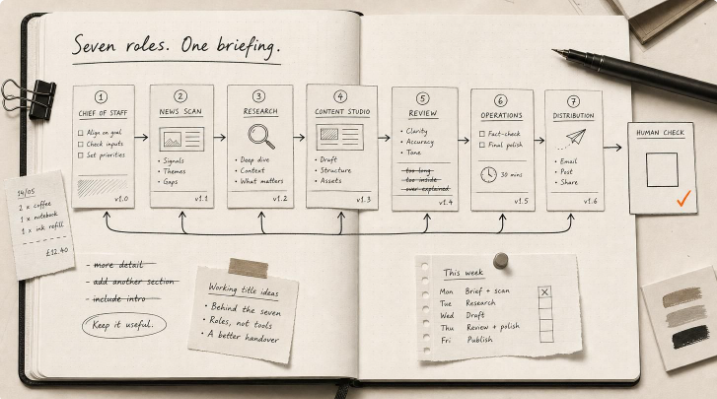
Hermes Agent Bot Mode: how I run a fleet of AI bots
Hermes Agent bot mode: seven AI bots that research, draft and review each other's work, and why none...

How I set up Grok Bot (and what I use it for)
How I set up Grok Bot: a Chief of Staff bot, three specialists, a weekly cadence, and a hard human g...

How I Rank on Google Using Claude Cowork
I'm not an SEO expert. Here's the Claude Cowork workflow Claude and I built to rank on Google — and ...

How I Built a CRM With AI in an Afternoon (Using Hermes)
I built a working CRM with AI in an afternoon: structured files an agent reads, updates, and emails ...