How to read a financial filing with AI
By Riz Pabani on 01-Jun-2026
If you work in financial services, you know the feeling. A document lands in your inbox that's too important to ignore and too long to actually read. A prospectus. An annual report. A credit agreement. Three hundred pages of careful language written so that, technically, nobody can sue the people who wrote it.
A couple of weeks ago the biggest version of that document arrived for everyone at once. SpaceX filed to go public, in what might be the largest IPO in history. The filing is one HTML file. 11.8 megabytes of it.
I wanted to see what was actually in it. So I asked Claude to read it and build me something I'd genuinely use. This post is how to read a financial filing with AI in practice — what I did, what it found, and the small change in how you ask that makes the whole thing work on any filing you're avoiding.
The filing nobody reads
SpaceX is going public as SPCX on Nasdaq. The S-1 is the registration statement, the document that legally lets you buy shares. It's where a company has to say everything: the money, the risks, the ownership structure, the bits the marketing never mentions.
It's also enormous and written for lawyers. The price and number of shares are still blank, which is normal at this stage. The valuation isn't stated anywhere, despite every headline quoting one. To get the real picture you have to read the thing, and almost nobody will.
That's the problem worth solving. Not just for SpaceX. For every dense filing that crosses a finance professional's desk.
What I asked Claude to do
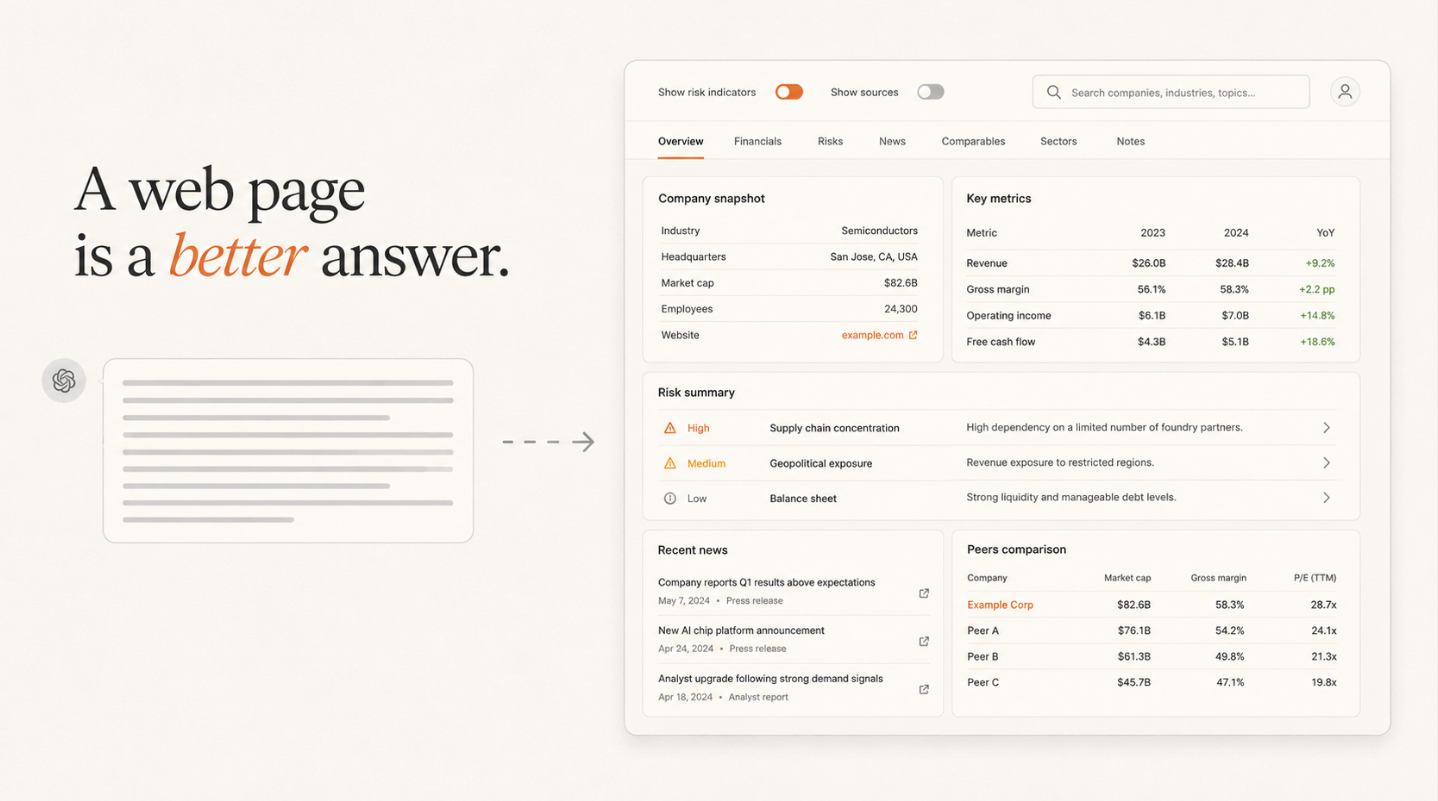
I didn't ask for a summary. If you ask AI for a summary you get a wall of text back, and a wall of text is just a shorter document you also won't read.
Instead I asked it to build a single web page, and gave it one design idea: a toggle at the top with two settings. "Retail view" explains everything in plain English, with the jargon unpacked. "Investor view" reveals every segment table, operating metric and risk factor underneath. Same page, two depths, depending on who's reading.
That's it. The whole prompt was close to "read this filing and build me an HTML page that does this." Claude did the reading, the structuring, the tables, the colour-coding and the navigation.
Here it is — try the toggle at the top. You can also open the full-screen version.
What it surfaced
Here's what the page made obvious in about a minute, none of which you'd get from the headlines.
SpaceX is really three businesses bundled into one share. Starlink is the profit engine: $11.4bn of revenue last year, growing close to 50%. That cash is funding two expensive bets, the Starship rocket programme and a new AI arm (xAI and Grok) that lost more than $6bn. When you buy a share, you buy all three at once.
The company is profitable on one measure and lossmaking on another. Adjusted EBITDA was positive at around $6.6bn. The operating result was a loss of about $2.6bn. Both numbers are true. Which one you care about depends entirely on whether you believe the heavy spending pays off later.
And the detail most people skip past: you'd be buying Class A shares with one vote each. Musk and other insiders hold Class B shares with ten votes each, and they elect most of the board. You'd own a slice of the upside and have almost no say in how the company is run. The filing is direct about this. SpaceX will be a "controlled company."
None of that is a verdict on the investment. It's just what's in the document, made readable. That's the job.
Why HTML beats a chat summary
This is the part worth stealing, and it's not really about SpaceX at all.
Most people treat AI like a search box. Ask a question, get a paragraph. That's fine for quick facts. It's a poor fit for anything you need to navigate, compare, or hand to a colleague.
A web page is a much richer container. It can hold tables, a contents menu, expandable sections, a search-on-the-page, and that retail-or-investor toggle. You can send it as a link. Someone can open it on their phone. They can jump to the risks section without scrolling past everything else. A paragraph in a chat window can't do any of that.
The Claude Code team wrote about this recently, in a piece called "The unreasonable effectiveness of HTML". Their argument is simple: they've largely stopped asking AI for plain text and started asking for HTML, because the output is richer, easier to read, and far more likely to actually get read. Simon Willison made the same point the same week. It's a tiny change in what you ask for, with a big change in what comes back.
You don't need to know what HTML is to use this. You just say "build me a web page" instead of "summarise this." The machine handles the rest.
A side bet, while we're here: PowerPoint's days are numbered. If your agent can edit an HTML page on demand, you don't really need an app to manage your slides. You describe what you want, the page rebuilds, and you carry on. It's a bit like a Big Four partner barking at a graduate to redo the deck before the 9am meeting. That's a separate post, but it's the same shift in how you think about output.
This works on anything dense
The SpaceX filing was a good test because it's about as long and as dense as documents get. But the technique isn't about IPOs.
Point it at a 200-page annual report and ask for a page that pulls out the numbers that moved and the risks that are new this year. Point it at a fund prospectus and ask for the fees, the strategy and the lock-up terms in plain language, with the legal detail one click away. Point it at a credit agreement, a board pack, a research note you've been meaning to get through. The pattern is the same every time. Give it the document, describe the page you wish existed, let it build it.
This is what I mean when I say the cost of building things with AI has collapsed. A few years ago, turning a filing into an interactive briefing tool would have been a project. Now it's a sentence and a few minutes.
The caveats, because this is finance
I'm not here to sell you magic, so here are the limits.
A summary is not the prospectus. The official document governs, always. If you're going to act on a number, check it against the source first. When I built the SpaceX page I had Claude flag every figure that came from press coverage rather than the filing itself, so I could tell the difference at a glance. That habit matters more in finance than anywhere else.
AI also gets things wrong. It can misread a table or carry a number from the wrong year. The page it builds is a faster way in, not a substitute for your own judgement. Treat it as a sharp intern who's read the whole thing and made you a briefing: useful, fast, and worth double-checking before you quote it in a meeting.
Try it, or let me show you
If you want to test this yourself, find the most boring, longest document on your desk right now. Drop it into Claude and ask it to build you a web page that makes it readable, with the plain-English version up top and the detail underneath. See what comes back.
If you work in financial services and you'd rather see it done properly on a real document of yours, that's exactly the kind of thing I do in a 1-2-1 session. We take something you actually have to deal with and I show you how to make AI handle it. If you're not sure whether it's right for you, message me and I'll tell you honestly.
Related Articles

AI cited my site 18,400 times and I had no idea
Google Search Console has a hidden report on how often AI Overviews and AI Mode show your site. Mine...

How my Grok Bot chief of staff grew into eight bots
Six weeks on, my Grok Bot chief of staff runs seven specialist bots. What they do each week, what br...
Claude skills for finance, and how to build your own
Claude skills for finance: the eight in Anthropic's Finance plugin, what they did on real data, and ...
How to create Claude Cowork skills by doing the work first
Build Claude Cowork skills that work first time. Do the task once, correct it, then have Claude pack...