OpenClaw vs Hermes vs Cowork: Honest Comparison
By Riz Pabani on 09-Apr-2026
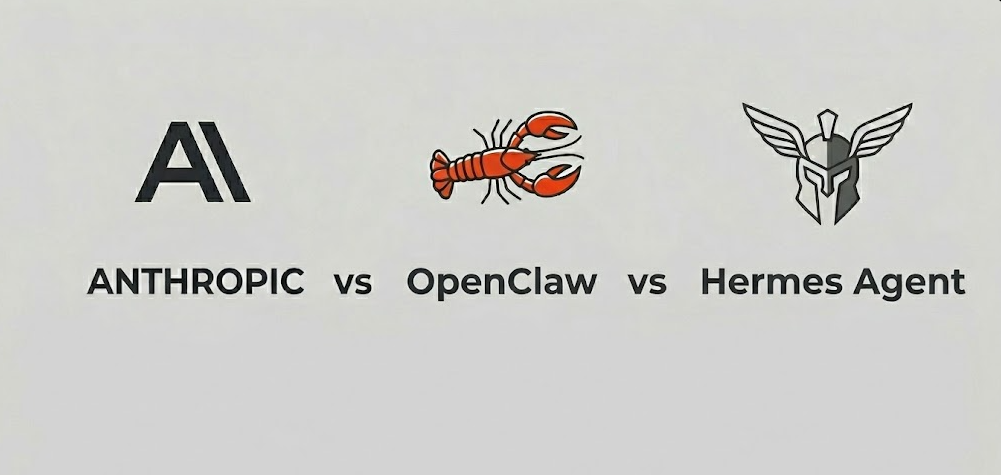
Three products. Three completely different ideas about what a personal AI agent should be. I've used all of them, built workflows in two of them, and spent more hours than I'd like to admit configuring the third. This is what I actually think.
If you've been reading the AI agent hype and wondering which one to try first, this should save you a few weekends of trial and error.
What each one actually is
OpenClaw is a self-hosted gateway for AI agents that lives inside your messaging apps. Discord, Slack, Telegram, WhatsApp, Signal, iMessage, Teams, Matrix. It connects to all of them. The mental model isn't "open a browser tab and chat." It's "message your assistant from wherever you already are, and it does things."
It can clear your inbox, manage your calendar, send emails, check you in for flights, and run recurring jobs on a schedule. There's a gateway architecture underneath with session logic, pairing flows, plugins, and skills. It feels more like running infrastructure than using an app.
The right metaphor: OpenClaw is a self-hosted executive assistant that happens to live in your chat apps.
Hermes Agent is an open-source, model-agnostic agent from Nous Research. Its pitch is different from OpenClaw's. OpenClaw is about reach and operations. Hermes is about learning. It has a built-in learning loop. It creates skills from experience, improves them during use, persists knowledge across sessions, and builds a model of who you are over time.
It runs everywhere: local, Docker, SSH, Daytona, Singularity, Modal. It supports 14+ messaging platforms. And it has a formal migration path from OpenClaw, which tells you something about where it thinks the market is going.
The right metaphor: Hermes is the agent that wants to become your evolving digital collaborator, not just a bot that answers prompts.
Claude Cowork is Anthropic's desktop agent for knowledge work. It runs in Claude Desktop, can access your local files, coordinate sub-agents, create actual deliverables, and run scheduled tasks. Anthropic positions it very deliberately: not a hacker tool, not a terminal-first assistant, not a "message your bot on WhatsApp" system. It's a guided desktop work surface for delegating messy multi-step tasks to AI.
The right metaphor: Cowork is a competent colleague sitting at your desk, working on your files.
All three of these sit at Level 5, the agent harness level, where the AI has a heartbeat and acts without being asked. But they got there via completely different routes, and that's what makes this comparison interesting.
The strategic difference
These products are solving different jobs. Understanding which job you actually need solved is the whole game here.
OpenClaw optimises for reach and autonomy across channels. It wants your assistant to live where you already live. WhatsApp, Telegram, Slack. It also wants to do recurring operational work through heartbeat checks and cron. If you've ever thought "I wish I could just text my assistant and have it actually do the thing," that's OpenClaw's pitch.
Hermes optimises for agent evolution and portability. It's trying to build a stronger memory and learning substrate, while staying model-agnostic and deployment-flexible. It's the most explicit about the agent becoming better over time. Not just remembering what you said last Tuesday, but actually getting more capable the longer you use it.
Cowork optimises for trust, polish, and accessibility. Anthropic keeps the environment tighter: desktop app, selected file access, scheduled tasks, plugins, projects. There's a strong emphasis on human oversight and producing actual outputs (documents, spreadsheets, research summaries) rather than running background operations.
The practical translation:
"I want AI to work on my desktop files and give me a finished output without me learning devops." That's Cowork.
"I want a persistent assistant on Telegram and WhatsApp that can automate things, and I'm comfortable running infrastructure." That's OpenClaw.
"I want an open-source agent that can remember, learn, improve, and run on whatever provider I choose." That's Hermes.
Setup and onboarding
This matters more than most comparison articles admit. The best agent in the world is useless if you can't get it running.
Cowork is the easiest by a wide margin. It's available through Claude Desktop on macOS and Windows. If you're on a paid Claude plan (Pro, Max, Team, Enterprise), you already have access. There's even a readiness check built in. You don't touch a terminal. You don't configure a server. You open the app and start delegating.
For AI-curious professionals who aren't developers, this is the right starting point. Full stop.
OpenClaw is fast for technical users. The getting-started docs claim five minutes from install to a working chat session. That's accurate for the initial setup. But the initial setup isn't the real work. The real work is everything after: channels, permissions, pairing, security, skills, heartbeat, cron, and gateway operations. I've written about my own OpenClaw setup. It's powerful, but it's not a casual afternoon project.
Hermes sits between the two. It's still an open-source agent, so it's not consumer-simple. But the docs are trying hard to reduce friction. Broad backend support. Strong profile isolation. And here's the interesting part: Hermes now has an explicit migration path from OpenClaw. You can import your settings, memories, skills, and API keys. That's not just a feature. That's a competitive statement.
Memory and learning
This is where the three products diverge most sharply.
OpenClaw's memory is file-based and transparent. It centres around MEMORY.md, daily notes in memory/YYYY-MM-DD.md, and optional DREAMS.md. Under the hood, it indexes these into per-agent SQLite databases with hybrid retrieval. So it's not just a markdown file. There's real search and retrieval plumbing underneath.
The vibe is operator-oriented. You can inspect everything, tune it, reason about exactly what your agent remembers and why. That's great for technical users.
Less magical for everyone else.
Hermes' memory is the most ambitious of the three. It markets a closed learning loop: agent-curated memory, skill self-improvement, cross-session recall, and a deepening user model. It references an external memory ecosystem and Honcho-based user modelling.
The practical implication: Hermes is trying to give you a system that doesn't just remember facts, but gets better at being your agent. That's a bigger proposition than "stores notes and retrieves them later."
The tradeoff is obvious. More ambitious means harder to predict. But if memory and self-improvement matter most to you, Hermes has the strongest positioning right now.
Cowork's memory works within projects. You get persistent workspaces, folder instructions, and project-level context. But Anthropic is upfront about a limitation: memory is supported within projects and is not retained across standalone Cowork sessions.
That's a meaningful gap. Cowork memory is good enough for repeated work inside a defined project. It's not the same as a long-lived self-hosted agent building a model of you over months across every channel and environment.
On memory, my honest ranking: Hermes for long-term ambition. OpenClaw for transparent, tunable, file-based memory you can inspect. Cowork for mainstream project-scoped memory that just works inside its boundaries.
Automation and persistence
OpenClaw has the richest automation model. Its heartbeat runs routine monitoring every 30 minutes by default. Cron handles precise schedules and one-shot reminders. On top of that you've got hooks for event-driven reactions, standing orders for persistent context, and Task Flow for coordinating multi-step workflows.
It's closer to running a service than using an app.
Hermes matches this with built-in cron, delivery to any platform, subagents, and multiple runtime backends. The difference is mostly philosophical: OpenClaw's automation model feels like a gateway-first assistant OS. Hermes frames automation as part of a broader self-improving agent architecture. In practice, both are very capable for recurring jobs and persistent operation.
Cowork supports scheduled tasks, but there's a ceiling. Tasks only run while your computer is awake and the Claude Desktop app is open. Close the app or let your machine sleep, and active tasks stop.
For many professionals, that's fine. You schedule your morning briefing, your end-of-day summaries, your weekly reports. The desktop is on during working hours anyway. But for serious always-on automation, it's a real constraint.
On persistence: OpenClaw and Hermes for always-on self-hosted operations. Cowork for desktop-scheduled delegation during working hours.
Channels and reach
This one is a landslide.
OpenClaw is explicitly a channel gateway. Discord, Google Chat, iMessage, Matrix, Teams, Signal, Slack, Telegram, WhatsApp, Zalo, and more. If you want your assistant to meet you inside Telegram or WhatsApp, this is the product that's built for it.
Hermes is arguably even broader: 14+ platforms from one gateway, including CLI, Telegram, Discord, Slack, WhatsApp, Signal, Matrix, Mattermost, Email, SMS, DingTalk, Feishu, WeCom, and Home Assistant. For cross-platform reach plus strong memory, Hermes is very compelling.
Cowork is desktop-first. Pro and Max users can message Claude from mobile while the desktop works on tasks. But that's not the same as a general messaging-gateway system across WhatsApp, Telegram, Slack, and the rest.
If "I want an assistant in my messaging apps" is your primary requirement, Cowork isn't the right mental model.
Skills, plugins, and extensibility
OpenClaw has a mature system of skills, plugin slots, channel plugins, and dynamic skill refresh. Power users can extend it into something very custom. The docs are honest about the tradeoff: "skills should be treated as trusted code." That's great transparency. It's also a sentence that should give non-technical users pause.
Hermes has possibly the strongest story here. Open skills ecosystem. AgentSkills portability. MCP support. Optional and bundled skill catalogues. And agent-managed skills, where the agent can create and improve its own skills. That last part is the differentiator. Hermes isn't just configurable. It's trying to become adaptively configurable.
Cowork supports plugins that bundle skills, connectors, and sub-agents into a package. Anthropic is clearly making extensibility understandable for mainstream users rather than exposing a sprawling framework. Cleaner, but more opinionated. Less raw control than OpenClaw or Hermes. Simpler mental model.
Security
This is where non-technical professionals usually underweight the differences. And it matters.
OpenClaw is refreshingly blunt in its security docs. It assumes a personal assistant trust model: one trusted operator per gateway. Not a hostile multi-tenant security boundary. The docs remind you that the assistant may execute shell commands, read and write files, access network services, and message people if you give it that authority.
That honesty is excellent. It also tells you exactly what you're dealing with: a powerful delegated runtime. If you misconfigure it, the problem isn't the concept of agents. The problem is that you granted real capability to software without the right guardrails.
My translation: OpenClaw isn't dangerous because it's bad. It's dangerous because it's real.
Hermes has the most thought-out defence-in-depth model of the three. It stacks seven layers of protection, from user authorisation and dangerous command approval through container isolation, MCP credential filtering, prompt injection scanning, and cross-session isolation. On paper, it's a serious security posture.
It suggests Hermes is trying to keep the power of a self-hosted agent while being systematic about control boundaries.
Cowork feels safest because it's polished and vendor-hosted. But Anthropic's own docs include warnings worth reading carefully. Cowork has unique risks due to internet access and its agentic nature. Network egress controls don't apply to the web search tool or MCPs. And this is the big one for enterprise teams: Cowork activity isn't captured in Audit Logs, Compliance API, or Data Exports during preview. Anthropic explicitly says not to use it for regulated workloads.
Don't confuse "nice UI" with "fully enterprise-governed." That applies to all three products, but it's most tempting to forget with Cowork because it looks so polished.
Cost and business model
This changed recently and it matters.
Cowork is part of the Claude ecosystem, available on paid plans. Straightforward. You pay for Claude, you get Cowork.
OpenClaw and Hermes are open-source and self-hosted, but "free" is misleading. You still pay for infrastructure, model API usage, setup time, and maintenance. Hermes says it can run on a £4 VPS. OpenClaw has docs for tracking token usage and API costs. Both are real ongoing expenses.
Here's the wrinkle that nobody saw coming. On April 4, Anthropic blocked Claude Pro and Max subscribers from using their flat-rate plans with OpenClaw. You can still use OpenClaw with Claude, but only through pay-as-you-go API billing. Anthropic's stated reason: "our subscriptions weren't built for the usage patterns of these third-party tools." Some users reported cost increases of up to 50x their previous monthly spend.
The timing raised eyebrows. OpenClaw's creator joined OpenAI in February. Anthropic's restrictions came weeks later. Draw your own conclusions.
That shift matters strategically. It makes Cowork relatively more attractive for people who want a polished Claude-native workflow. It makes OpenClaw meaningfully more expensive for users who'd been leaning on Claude subscription economics. And it indirectly strengthens Hermes' model-agnostic story, because Hermes isn't architecturally tied to a single vendor's pricing decisions.
Migration and lock-in
Cowork has the strongest vendor integration and the smoothest consumer experience. It's also the most vendor-shaped environment. It's tied to Claude Desktop and Anthropic's product roadmap. If Anthropic changes direction, your workflows go with it.
OpenClaw is open-source and self-hosted. Your memory, workspace, and configuration are inspectable and portable in ways hosted products aren't.
Hermes is the most interesting here. It now includes a formal migration path from OpenClaw. You can import memories, instructions, skills, model settings, and messaging platforms. That's a real anti-lock-in move.
If you care about future flexibility, the open-source options win. If you care about speed-to-value this week, Cowork wins.
Which one for which person
Executive, operator, or founder who wants leverage fast: Start with Cowork. Desktop app, low setup burden, strong deliverable orientation. Built for documents, research synthesis, extraction, and file organisation. You'll feel the value within the first session.
Technical founder or ops-heavy power user who wants an assistant in messaging apps: Start with OpenClaw. Channel-first architecture, heartbeat, cron, gateway model. This is the closest thing to a self-hosted executive assistant. Budget time for the setup.
Professional who wants an open-source long-term agent that actually evolves: Start with Hermes. Strongest learning-loop story, strong security model, cross-session identity and memory, profiles, multiple backends, migration path from OpenClaw.
Team lead in a regulated or compliance-heavy environment: Be careful with all three. Cowork says not to use it for regulated workloads during preview. Open-source agents require even more careful self-governance. Don't assume any of these are enterprise-governed by default.
The real tradeoffs
OpenClaw makes AI feel reachable. You can text it from your phone, and it actually does things. But it never feels effortless. It rewards operators and punishes anyone who doesn't want to think about trust boundaries, gateway configuration, and channel pairing.
Hermes makes AI feel like it's growing with you. The learning loop, the self-improving skills, the deepening memory. It's the most intellectually ambitious open-source option I've seen. The cost is legibility. A mainstream user opening Hermes for the first time won't immediately grasp what they're looking at.
Cowork makes AI feel like a competent colleague. You delegate, it delivers. But it won't follow you to WhatsApp at 10pm, it won't run while your laptop's asleep, and it won't remember you across standalone sessions. It's the most polished product here, and the most bounded.
My actual recommendation
If you're reading this blog, you're probably AI-curious but not necessarily an infrastructure person. So here's how I'd think about it.
Start with Cowork. It's the best way to feel what delegated AI work looks like without drowning in setup. Give it a real task, not "write me a haiku," but "go through these ten PDFs and pull out every pricing clause." That's when you'll get it.
Graduate to OpenClaw when you want AI to become an always-on assistant reachable from your existing communication channels. You'll know you're ready when the desktop-only constraint of Cowork starts frustrating you. When you find yourself thinking "I wish I could just message this thing from my phone at 10pm and have it ready by morning," that's when OpenClaw makes sense.
Watch Hermes closely. It's the most interesting long-term bet for an open personal agent. The learning loop, the memory architecture, the migration path from OpenClaw. It's clearly positioning itself as the upgrade. Whether it delivers on that promise will depend on execution, but the design intent is the most ambitious of the three. If you go with Hermes, my Hermes Agent tips cover the configuration and best practices I wish I'd known on day one.
I'll give you a concrete example. I tried running the same task on all three: an AI news briefing every morning, researched and emailed to me before I sit down at my desk.
OpenClaw was the most fiddly. The cron jobs would frequently fail or just not fire. Getting it stable took more babysitting than the briefing was worth. Cowork actually worked well for the research and summary part, but it was relying on my browser to send the emails via agent mail. That meant my laptop had to be open and Chrome had to be running. Not ideal for a "before I wake up" workflow.
Hermes was the surprise. I had the AI news briefing running within the first session. Agent mail set up quickly. The research skill slotted in without drama. It just worked, and it kept working. That's the kind of difference that doesn't show up in a feature matrix but matters enormously in practice.
One sentence version: Cowork is the best first date. OpenClaw is the best ops assistant. Hermes is the best long-term bet for an open personal agent.
If you're also deciding which chatbot to pay for alongside an agent, see my guide to which LLM to subscribe to.
If you want to see any of these in action, book a session. I'll show you what they can actually do, not just what the docs promise.
Related Articles
AI cited my site 18,400 times and I had no idea
Google Search Console has a hidden report on how often AI Overviews and AI Mode show your site. Mine...
How my Grok Bot chief of staff grew into eight bots
Six weeks on, my Grok Bot chief of staff runs seven specialist bots. What they do each week, what br...
Claude skills for finance, and how to build your own
Claude skills for finance: the eight in Anthropic's Finance plugin, what they did on real data, and ...
How to create Claude Cowork skills by doing the work first
Build Claude Cowork skills that work first time. Do the task once, correct it, then have Claude pack...