The Lobster That Molted Three Times: What OpenClaw Tells Us About the Future of AI Agents
By Riz Pabani on 16-Feb-2026
A weekend project. A handful of markdown files. A lobster emoji.
That's all it took for Peter Steinberger to build what many are calling the most significant AI moment since ChatGPT launched in November 2022.
OpenClaw — the open-source AI agent that went from zero to 180,000+ GitHub stars in weeks — just had its creator hired by OpenAI. And the story of how we got here is a masterclass in everything happening in AI right now: the power of elegant architecture, the messiness of trademark law, the pull of open source, and the cold reality of big tech deal-making.
The Architecture That Changed Everything
Here's what blew my mind about OpenClaw when I first started exploring it.
The architecture is brilliant. A handful of markdown files to define your agent, a mechanism for giving it longer-term memory, and kablamo — you have an employee.
Not a chatbot. Not a copilot. An employee.
OpenClaw doesn't wait to be prompted. It monitors your inbox, manages your calendar, books your flights, handles your correspondence. It lives inside the messaging apps you already use — WhatsApp, Telegram, Signal — and acts on your behalf. Steinberger himself described it as "the AI that actually does things."
The elegance is in the simplicity. The core is an agentic loop with a gateway and daemon model, a skills plugin system, and local storage for persistent memory. You define your agent's personality and capabilities in markdown. You give it access to your tools. It learns from every interaction.
On the Lex Fridman podcast last week — a three-hour deep dive that's essential listening for anyone in this space — Steinberger revealed something remarkable: the agent can modify its own source code. He didn't plan for this. He simply let the AI know where its own code lives, initially so it could help him debug. Users quickly discovered they could tell the agent "I don't like this feature" and it would rewrite itself.
Lex's reaction said it all: this is a moment in programming history where a powerful system used by millions of people can rewrite and modify itself.
And here's the kicker — Steinberger doesn't even type anymore. He runs four to ten AI agents simultaneously, using voice input to build his software. As he put it: "These hands are too precious to be used for typing."
The Name-Change Drama (And What It Tells Us About Anthropic)
The naming saga deserves its own Netflix series.
It started as "Clawd" — a playful pun on Claude with a lobster claw. Then Clawdbot. Anthropic's legal team sent what Steinberger described as a "friendly but firm" email about trademark similarity. Fair enough — when your open-source project is riding on the brand recognition of someone else's company, you're on borrowed time.
So it became Moltbot. The lobster molts to grow. Poetic. Chosen in a chaotic 5 AM Discord brainstorm.
But Moltbot lasted roughly 48 hours. In the gap between releasing the old social media handles and claiming new ones, crypto scammers swooped in within five seconds — literally — and snatched the accounts. Steinberger called it "the worst form of online harassment I've experienced" and came close to deleting the entire project.
The final rebrand to OpenClaw required what one commentator called "Manhattan Project-level secrecy" — decoy names, coordinated platform changes, and $10,000 spent buying a Twitter business account to secure the handle.
Here's what's interesting about Anthropic's role in all this. They protected their trademark — which is entirely reasonable. But in doing so, they inadvertently pushed the fastest-growing open-source AI project away from their ecosystem. OpenClaw was originally built on Claude. The rename forced a philosophical shift toward model-agnosticism. Before renaming to OpenClaw, Steinberger asked Sam Altman if the name was okay. Not Anthropic. Altman.
Sometimes the best deals are the ones your competitor's legal team makes for you.
OpenAI's Master Move
And that brings us to yesterday's bombshell.
Sam Altman announced that Steinberger is joining OpenAI to "drive the next generation of personal agents." Both Meta's Zuckerberg and Altman had been courting him with billion-dollar offers. For a project that was haemorrhaging $10,000 to $20,000 a month to run.
The Zuckerberg courtship is a story in itself. He reached out via WhatsApp. When Steinberger proposed a call, Zuckerberg asked for ten minutes — he was finishing some code. The call ended with the two of them arguing for ten minutes about whether Claude Code or Codex is the better programming tool. Zuckerberg had been running OpenClaw on his own machine, giving granular product feedback, calling specific features "great" or "shit" in real time. Steinberger called it "the biggest compliment."
But he chose OpenAI. His reasoning was telling: "I could totally see how OpenClaw could become a huge company. And no, it's not really exciting for me. I'm a builder at heart. What I want is to change the world, not build a large company, and teaming up with OpenAI is the fastest way to bring this to everyone."
OpenClaw moves to a foundation. Stays open source. OpenAI sponsors it.
This is vintage Altman deal-making. Before this move, OpenAI had a critical gap: no consumer messaging surface. ChatGPT is a destination app. OpenClaw lives inside the apps people already use. One analyst noted that OpenAI now has coverage across all four layers of the agent stack — execution, protocol, enterprise, and consumer. Before February 15th, only Anthropic could claim presence across all four.
The Honest Truth for Open Source
But let's be honest about what's actually happened here.
The pattern is becoming the dominant strategy in AI: open source builds the community and adoption, then the company that acqui-hires the creator builds the premium product on top.
Steinberger told Lex: "My conditions are that the project stays open source. Maybe it's gonna be a model like Chrome and Chromium. I think this is too important to just give to a company and make it theirs."
Chrome and Chromium. Think about that comparison. Chromium is technically open source. Chrome is the product that prints money for Google. The open-source foundation feeds the proprietary machine.
OpenClaw will "stay open source." But its creator now works for OpenAI. His stated mission is to build agents that become "core to our product offerings." The gravity of a $500 billion company has a way of bending open-source trajectories.
For those of us building with these tools, this matters. The tool that promised sovereignty over your data and your AI agent is now organisationally tethered to the company that just started testing ads in ChatGPT. As of February 9th, free and lower-tier ChatGPT users are seeing sponsored content in their conversations. Anthropic ran a Super Bowl ad taking a swipe at exactly this. The irony isn't lost on anyone.
What This Means for Enterprise AI
Steinberger made a prediction on the Lex podcast that should make every SaaS founder nervous: OpenClaw-style agents will kill 80% of apps. "Every app is just a very slow API now, if they want it or not."
Why pay for a project management tool when your agent can manage your tasks directly? Why open a food delivery app when your assistant already knows your preferences, your schedule, and your dietary requirements?
For those of us in financial services and enterprise consulting, the implications are massive. The agent layer sits between the user and every service. Whoever controls that layer controls the relationship.
This is why OpenAI paid billions. This is why Anthropic is building Claude Code. This is why every major lab is pivoting to agents. And it's why we saw $285 billion wiped off SaaS stocks when Anthropic shipped 11 plugins.
The Takeaway
A solo developer in Austria built a weekend project with markdown files and an agentic loop. It became the fastest-growing open-source project in GitHub history. Three name changes, a trademark dispute, crypto scammers, security nightmares, and a bidding war later — it's now the foundation of OpenAI's consumer agent strategy.
The architecture was simple. The implications are not.
We're watching the agent layer of the internet being built in real time. The question isn't whether AI agents will become your digital employees. It's who will own the relationship between you and your agent.
Right now, that answer just got a lot clearer.
Want to understand how AI agents fit into your workflow? Book a session and we'll map out what's actually useful for your role — not the hype, the practical reality.
Related Articles
AI cited my site 18,400 times and I had no idea
Google Search Console has a hidden report on how often AI Overviews and AI Mode show your site. Mine...
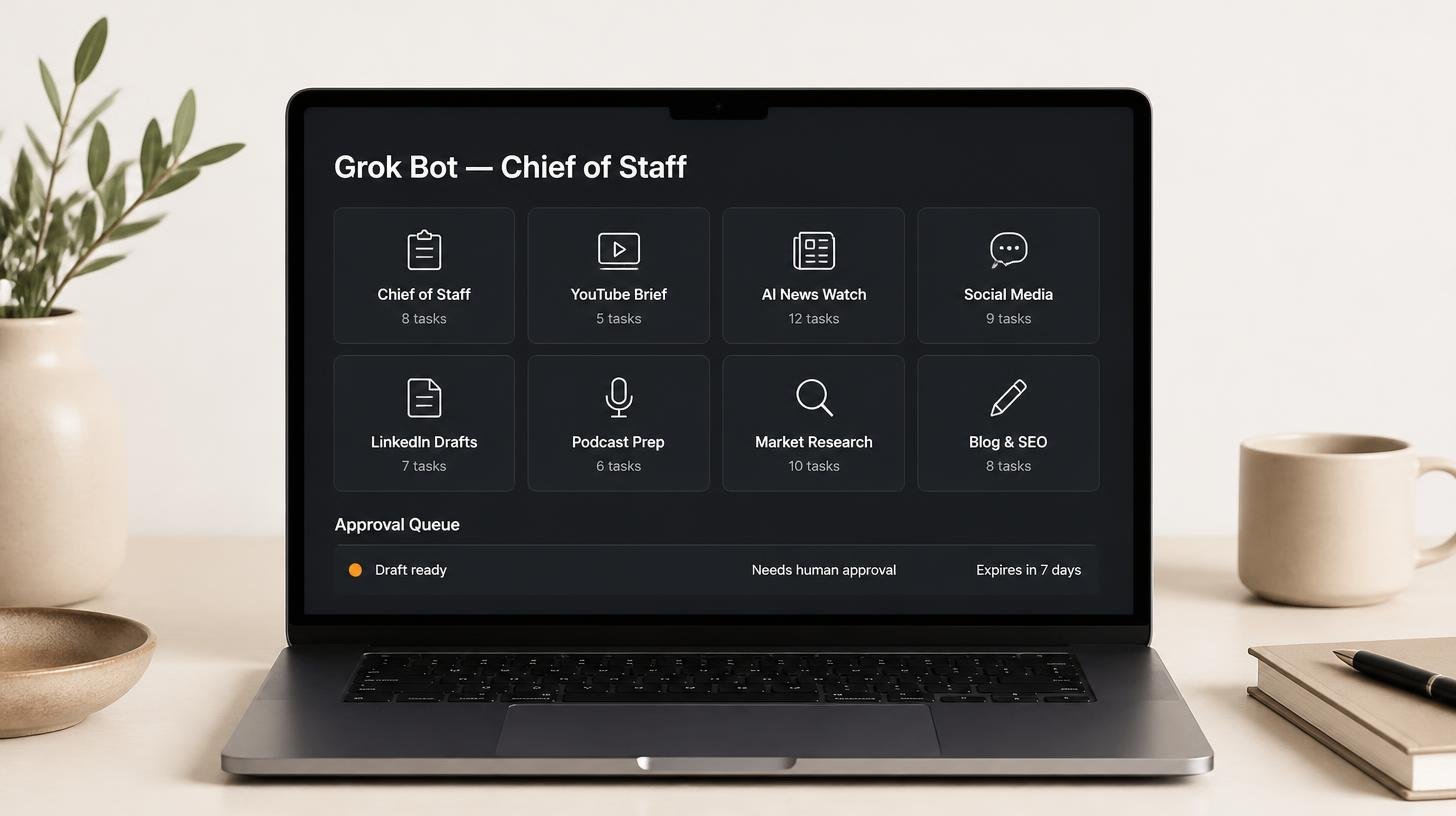
How my Grok Bot chief of staff grew into eight bots
Six weeks on, my Grok Bot chief of staff runs seven specialist bots. What they do each week, what br...
Claude skills for finance, and how to build your own
Claude skills for finance: the eight in Anthropic's Finance plugin, what they did on real data, and ...
How to create Claude Cowork skills by doing the work first
Build Claude Cowork skills that work first time. Do the task once, correct it, then have Claude pack...