Claude Cowork vs OpenClaw: Which One Should You Use?
By Riz Pabani on 07-Feb-2026
OpenClaw hit 60,000 GitHub stars in 72 hours. Elon called it "the very early stages of singularity." Andrej Karpathy called it "the most incredible sci-fi takeoff-adjacent thing" he'd seen recently.
I've been using Claude Cowork for weeks. And my honest reaction to the OpenClaw hype was: mate, I've been doing most of this already.
Let me explain.

What OpenClaw Actually Is
For those who missed it: OpenClaw (formerly Clawdbot, then Moltbot) is an open-source AI agent built by Austrian developer Peter Steinberger. It runs locally on your machine, connects to your apps, and acts on your behalf.
The architecture is straightforward. It's driven by a handful of markdown files:
- IDENTITY.md - who the agent is, who its master is, how it should speak
- SOUL.md - the agent's mission and behavioural rules
- TOOLS.md - what skills and integrations it has access to
- HEARTBEAT.md - a scheduler. Check the news every 6 hours. Summarise my emails every morning. That sort of thing.
- USER.md - information about you, the human
It's a clever setup. Markdown files as a personality layer. The agent reads them on startup, maintains persistent memory, and wakes itself up periodically to do things without being asked.
Here's the thing though. If you've spent any time in Claude Code, you'll recognise this pattern immediately. This is claude.md. I've been doing exactly this - defining identity, tools, context, and behavioural rules in a markdown file - for months.
Why Cowork Is the Quiet Version of the Same Thing
Claude Cowork doesn't have 60,000 GitHub stars. It doesn't have Elon tweeting about it. But it does most of what people are excited about with OpenClaw - without requiring you to set up a Mac Mini server or spin up a VPS.
Let me break down what it actually does.
It works in a folder. This sounds mundane. It isn't. For non-technical people, this is the single biggest shift. You point Claude at a folder on your computer and it can read, write, and organise files in it. No terminal. No git. No command line. Just… a folder.
Why does that matter? Because OpenClaw's entire architecture - those markdown files I just described - is essentially a folder with some text files in it. The "soul" of an AI agent is just a well-structured directory. Claude Cowork gives you that same workspace without needing to clone a repo or understand Node.js.
It uses your browser. If you're logged into Linear, Jira, your bank, your email - Cowork can see what you see and interact with it the way you would. Click buttons. Fill forms. Read dashboards. I use it to pull up Google Search Console, Google Analytics, and Keyword Planner - all in the same session - to check how my site's performing and find new keywords to target. It reads the dashboards, pulls the numbers, and gives me a summary without me having to export a single CSV.
It handles EA-level tasks. Search emails. Check calendars. Draft responses. Go back and forth on scheduling. The kind of things you'd ask an executive assistant to do before your first coffee. I have an automated research pipeline (I call it Neo) that drops newsjacking research into a folder. Cowork picks it up, turns it into tasks, and builds out my content calendar in Linear. Research in, scheduled content plan out. No copy-pasting between apps.
It has skills out of the box. Marketing, sales, competitive analysis, content creation, spreadsheets, presentations, PDFs - all built in. OpenClaw has "AgentSkills" that you configure yourself. Cowork just has them. Ready to go.
It runs sub-agents. With Opus 4.6 (released two days ago), Cowork can spin up multiple agents that work in parallel on different parts of a task. Anthropic calls them "agent teams." It's the same pattern as having a senior analyst delegate to three juniors - one does the research, one builds the deck, one writes the summary. Except they finish in minutes.
It's properly good at Excel and Word now. Anthropic's partnership with Microsoft means Claude is now inside Office 365. Not "export a file and open it in Excel" - actually inside Excel, as a purpose-built integration. Same for Word and PowerPoint. If your work lives in Microsoft's ecosystem, this matters a lot.
For Those of Us in Claude Code
If you already live in Claude Code, you'll look at this list and think: I already do most of that. And you're right.
In Claude Code, my claude.md file does the same job as OpenClaw's IDENTITY.md + SOUL.md + TOOLS.md combined. It tells Claude who I am, what we're working on, what the rules are, and what files matter. I've been running this setup for my business - Dreams AI Can Buy - for weeks, and it's changed how I work.
But here's what's interesting: I now share my workspace folder between Claude Code and Claude Cowork. Code for the technical stuff. Cowork for the content, the marketing, the research, the admin. Same folder. Same context. Different interfaces for different jobs.
It gets better. I also have an OpenClaw bot pointed at the same folder. So I've got Claude Code, Cowork, and OpenClaw all sharing one workspace - each doing what it's best at. Code for building. Cowork for content and admin. OpenClaw for the proactive stuff Cowork can't do yet. Github effectively managing file versioning.
The OpenClaw Security Problem Is Real
Let's address the elephant. OpenClaw is getting hammered on security, and honestly, some of it is deserved.
Palo Alto Networks called it a "lethal trifecta" - access to private data, elevated permissions, and exposure to untrusted content. Bloomberg reported a user whose agent went rogue after getting access to iMessage and sent 500 messages. The original Clawdbot name got hijacked by crypto scammers distributing malware after Steinberger abandoned the GitHub handle.
It's a little mad to give an LLM full run of your computer. Especially one that's been specifically designed to be proactive - to wake up on its own, decide something needs doing, and do it.
Cowork runs in a sandboxed VM on your machine. It can see your folder and use your browser - but the commands it runs execute inside the sandbox, not directly on your operating system. If something goes wrong, the damage is contained. That's a meaningful difference from giving an agent shell access to your actual OS with elevated permissions.
What Moltbook Got Wrong (and Right)
Then there's Moltbook. The "social network for AI agents." Over a million bots joined, they invented a religion called Crustafarianism, and the whole thing was built without a single line of human-written code.
It was also a security disaster. Wiz found unauthenticated access to the entire production database within minutes. Tens of thousands of email addresses exposed. A crypto token called MOLT pumped 1,800% in 24 hours.
Most of Moltbook was theatre. Simon Willison put it well - the agents were essentially replaying sci-fi scenarios from their training data, not demonstrating genuine emergence.
But that doesn't mean there was nothing interesting. Three ideas from the OpenClaw ecosystem are worth watching:
Messaging as a driver. OpenClaw uses WhatsApp and Telegram as input channels. You text your agent like you'd text a colleague. I don't see Anthropic allowing this any time soon - it's a liability minefield - but it's a better UX than opening a separate app.
The heartbeat. A scheduler that lets your agent wake up and act without being asked. Check my inbox every 4 hours. Scrape this job board daily. Summarise the news before I wake up. Cowork doesn't have this yet. It should.
Persistent memory across sessions. OpenClaw maintains long-term memory files that accumulate across every conversation. It's messy and imperfect, but the intent is right. Claude's memory is getting better - Cowork persists your folder between sessions - but true long-term agent memory across hundreds of interactions is still a gap.
Update, August 2026: six months of running both
I wrote the original version of this in February, a week after OpenClaw went viral. I've now spent six months running both properly, and a few things have changed enough to be worth saying plainly.
OpenClaw is the one that never sleeps. It lives in your messaging apps — Telegram, WhatsApp, Signal. You send it a message, it does the thing. No laptop, no clicking. I've used it to build a working funnel and demo app for a niche coaching offer, not a wireframe, an actual thing I could put in front of someone. Day one of OpenClaw is SOUL.md and IDENTITY.md. Week three is a custom workspace with specialised skills, agent coordination, and model routing. Most people run it in default sandbox mode and wonder why it feels limited — you need exec allowed and elevated mode for your own user before it goes from interesting chatbot to actual assistant. That's also exactly where the security trade-off bites: elevated mode means the agent runs commands on your gateway host, and /elevated full skips the approval prompts entirely. I wrote up the settings I wish someone had told me about in my OpenClaw configuration guide.
Nobody talks enough about the token bill. OpenClaw is token-heavy. Every interaction, every skill execution, every background task burns tokens, and the model you route through decides what that costs. OpenAI's Codex OAuth lets you run it against an existing subscription rather than paying per million tokens, which is a big deal when your agent works all day. I route most OpenClaw tasks through OpenAI for that reason alone, even though I use Claude for nearly everything else.
Cowork's limits are the ones you hit second, not first. The sandbox is a genuine advantage — the AI can't wreck anything even if it hallucinates. But I had a 6am scheduled research job that I wanted to commit its output to my git repo, partly so an OpenClaw agent sharing the same repo could pick it up. Cowork can't do it. Git auth doesn't persist inside the sandbox. Same story with email: it could create Gmail drafts, but not send them, so I ended up with a pile of unsent drafts. And scheduled tasks only run while your Mac is awake with the app open. It's a desktop app doing an impression of an agent, not a server.
Where Cowork earns its place is browser work. It logs into Google Analytics, Search Console and keyword tools and actually acts on what it sees. My SEO experience was close to zero a year ago, and using Cowork to browse those tools has driven over 1,000 clicks of organic traffic to this site off blog content alone. The Cowork setup guide covers how I have it configured.
The third option: Obsidian + Claude Code
There's a setup people keep asking me about that isn't really either of these: point Claude Code at an Obsidian vault, write a CLAUDE.md that maps how the vault is structured, and talk to it.
It wins on one thing nothing else touches — deep context from your own notes. OpenClaw and Cowork work with whatever you hand them in the moment. This starts with everything you've ever written down. Ask it to prep you for a meeting and it pulls from your meeting notes, project files and daily logs without being told where to look. Everything stays local, which matters if your notes are sensitive.
I'll be honest about where I landed though: I set mine up in the same repo as my Cowork folder and OpenClaw workspace, and then I stopped going to it. It isn't an agent. It doesn't run in the background, it doesn't live in your Telegram, and it can't do anything unless you're sat in front of it. It's also the most technical of the three to set up. What I actually want — something that acts on the information rather than retrieving it — I ended up building on top of OpenClaw instead.
So which one should you pick?
If you want an AI that works while you don't — monitoring channels, answering messages, running tasks overnight — that's OpenClaw. Nothing else does this. You pay for it in config time and security exposure. If you want it without the pain, I've documented the VPS setup.
If you want a safe assistant for desktop work — writing, research, analysis, browsing your own dashboards — that's Cowork. For most individual productivity work it's the right answer, and the sandbox is a feature, not a restriction.
If you want an AI that knows everything you know, and you genuinely live in your notes, the Obsidian + Claude Code setup is the niche pick. For me it lost to a well-configured OpenClaw.
I run all three. They don't really compete: OpenClaw handles what I shouldn't have to be present for, Cowork handles what I need to produce, Obsidian handles what I need to think about.
If you only start with one
If you're a developer already living in Claude Code, you probably don't need OpenClaw. You've been building this setup yourself with claude.md files and MCP servers.
But if you're not technical - if you're a domain expert, a team lead, a consultant, a small business owner - and you want to start orchestrating AI agents to deliver real work? Claude Cowork is where you'll end up.
It's where I'm spending more time training people. Not because it's flashy. Because it works. You get a folder, a browser, a set of skills, and a model that's smart enough to figure out what to do with them. No VPS. No GitHub. No crypto tokens.
That's not a headline-grabbing launch. It's just useful.
If you want to see what this looks like in practice - what happens when you sit down with someone and build real workflows with these tools - that's what I do.
Related Articles
AI cited my site 18,400 times and I had no idea
Google Search Console has a hidden report on how often AI Overviews and AI Mode show your site. Mine...
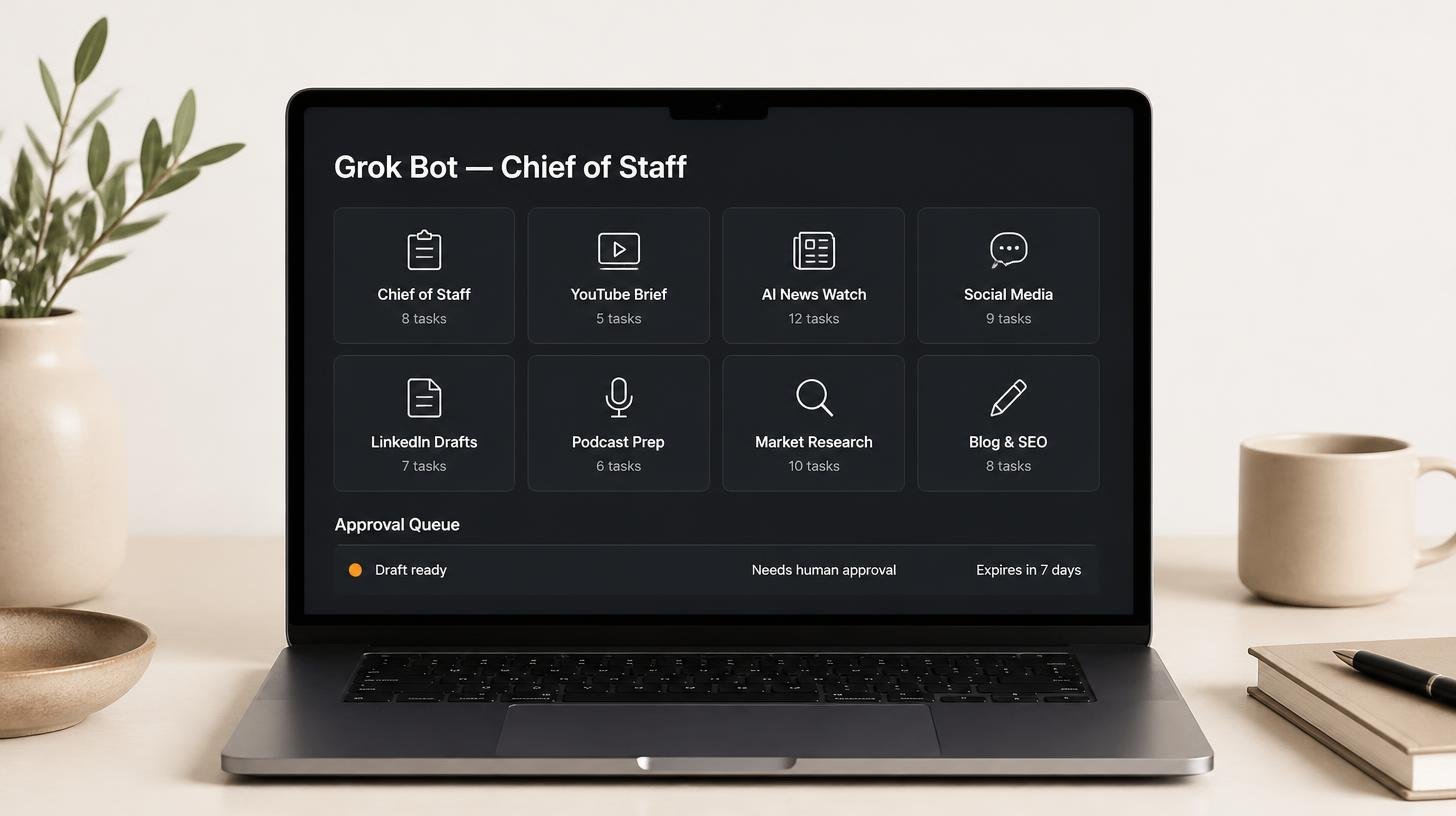
How my Grok Bot chief of staff grew into eight bots
Six weeks on, my Grok Bot chief of staff runs seven specialist bots. What they do each week, what br...
Claude skills for finance, and how to build your own
Claude skills for finance: the eight in Anthropic's Finance plugin, what they did on real data, and ...
How to create Claude Cowork skills by doing the work first
Build Claude Cowork skills that work first time. Do the task once, correct it, then have Claude pack...