Beyond Prompts: Why Context Engineering is AI's Future
By Riz Pabani on 07-Oct-2025
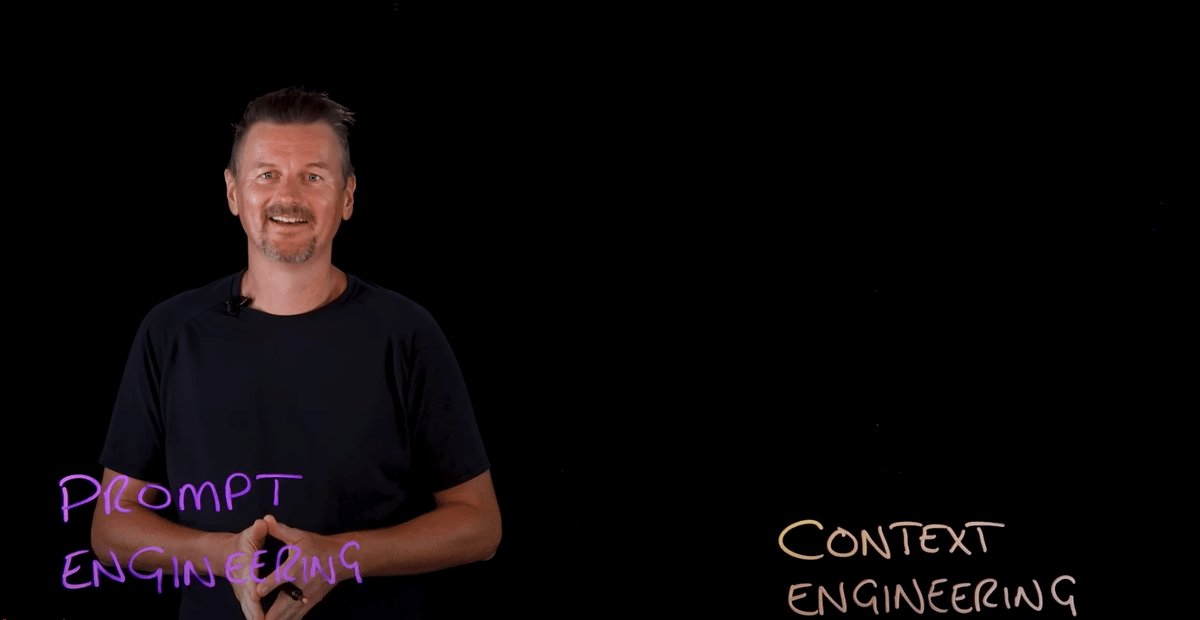
We've all heard of "prompt engineering" – the art of crafting the perfect question to get the desired response from an AI. But what if I told you that's only half the story? To build truly intelligent and reliable AI systems, we need to look beyond the prompt and into the world of context engineering.
Imagine you have an AI travel agent. You ask it to book a hotel in Paris for a conference. It books you a room at the Best Western... in Paris, Kentucky. The conference, of course, is in Paris, France. Was this a failure of your prompt? Or a failure of the AI to understand the context?
This is where the distinction between prompt engineering and context engineering becomes crucial.
What is Prompt Engineering?
Prompt engineering is the foundation of our interaction with large language models (LLMs). It's about carefully crafting our input to guide the AI's output. Think of it as giving the AI specific instructions. Some of the most effective techniques include:
Role Assignment: Tell the AI who to be. "You are a senior software developer" will yield a very different response than a generic request.
Few-Shot Examples: Show, don't just tell. Providing a few examples of what you want helps the AI understand the desired format and style.
Chain of Thought (CoT): Encourage the AI to "think step-by-step." This is especially useful for complex problems, as it forces the AI to lay out its reasoning.
Constraint Setting: Set clear boundaries. "Limit your response to 100 words" or "Only use the information I've provided" can help keep the AI focused.
The Bigger Picture: Context Engineering
If prompt engineering is about the question, context engineering is about the entire conversation. It's the broader discipline of providing the AI with everything it needs to understand the world around the prompt. This includes:
Memory Management: Just like humans, AI needs both short-term memory (to remember the current conversation) and long-term memory (to recall past interactions and preferences).
State Management: For multi-step tasks, the AI needs to keep track of where it is in the process. Did the flight booking succeed? What time does the rental car need to be ready?
Retrieval Augmented Generation (RAG): This allows the AI to access and retrieve information from external sources, like a company's travel policy or a real-time flight schedule.
Tools: LLMs can't browse the internet or book a hotel on their own. Context engineering gives them the "tools" to interact with the outside world through APIs and other integrations.
Better Questions vs. Better Systems
Ultimately, prompt engineering gives you better questions, while context engineering gives you better systems. When you combine them, you get an AI that can not only understand your request but also the context surrounding it.
So, the next time you're frustrated with an AI's response, remember that the problem might not be the prompt itself, but the lack of a richer context. The future of AI lies in building systems that can understand not just what we say, but what we mean.
This blog post is based on the concepts explained in the IBM Technology video: "Context Engineering vs. Prompt Engineering: Smarter AI with RAG & Agents"
Related Articles

AI cited my site 18,400 times and I had no idea
Google Search Console has a hidden report on how often AI Overviews and AI Mode show your site. Mine...
What a context window is, and why ChatGPT forgets
Why does ChatGPT forget things in long chats? A hands-on look at the context window, using two Harry...

How my Grok Bot chief of staff grew into eight bots
Six weeks on, my Grok Bot chief of staff runs seven specialist bots. What they do each week, what br...
Claude skills for finance, and how to build your own
Claude skills for finance: the eight in Anthropic's Finance plugin, what they did on real data, and ...